

08 January 2026 Indian Express Editorial
What to Read in Indian Express Editorial( Topic and Syllabus wise)
Editorial 1: Economy grows faster than expected, but underlying concerns remain
Context
India’s First Advance Estimates for FY 2025–26 project GDP growth at 7.4%, higher than market expectations and reinforcing India’s status as the fastest-growing major economy.
Background
- The global economy is witnessing slowdown due to high interest rates, geopolitical tensions, and trade fragmentation.
- Against this backdrop, India’s growth performance appears robust, driven largely by domestic demand, public capital expenditure, and services-sector resilience.
- However, headline growth numbers often conceal sectoral imbalances and structural fragilities.
Key Arguments
- Growth driven by select sectors
- Services remain the primary growth engine, particularly IT, finance, and trade-related activities.
- Manufacturing has shown improvement, supported by PLI schemes and infrastructure push.
- However, agriculture and allied activities have underperformed due to climate variability and stagnant productivity.
- Investment-led growth shows promise
- Gross Fixed Capital Formation (GFCF) has increased, reflecting strong public investment and gradual revival of private investment.
- Infrastructure spending on roads, railways, energy, and logistics has crowd-in effects.
- Consumption recovery remains uneven
- Urban consumption has recovered faster than rural demand.
- Weak rural income growth, partly due to erratic monsoons and inflation in essential commodities, remains a concern.
- External sector vulnerabilities
- Exports face headwinds from weak global demand.
- Rising geopolitical risks and protectionist tendencies could affect India’s trade outlook.
Critical Issues
- Jobless growth risk:High GDP growth has not translated proportionately into employment generation, especially for youth.
- Agricultural stagnation:Low productivity, fragmented landholdings, and climate stress threaten inclusive growth.
- Inflationary pressures:Though currently under control, food inflation and global energy price shocks pose risks.
- Fiscal sustainability:High public spending must eventually be complemented by private investment and revenue buoyancy.
Way forward
- Agricultural reforms:Focus on crop diversification, irrigation efficiency, agri-technology, and market access.
- Employment-intensive growth: Boost MSMEs, manufacturing clusters, and skill development aligned with industry needs.
- Private investment revival: Policy certainty, credit availability, and regulatory simplification are essential.
- Export competitiveness: Strengthen logistics, negotiate trade agreements, and diversify export baskets.
Conclusion
While the 7.4% growth projection signals macroeconomic strength, sustaining high growth requires addressing structural bottlenecks, ensuring employment creation, and reducing sectoral imbalances. Headline GDP figures must be matched by improvements in livelihoods and resilience.
Editorial 2: Supreme Court’s reprimand should be a wake-up call for air pollution governance
Context
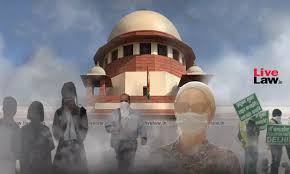
The Supreme Court has strongly reprimanded air pollution regulatory authorities, particularly the Commission for Air Quality Management (CAQM), for failing to effectively diagnose and address the persistent air pollution crisis in Delhi-NCR. The Court noted that pollution remains dangerously high even outside peak winter months, reflecting deep governance failures.
Background
Delhi-NCR experiences hazardous air pollution levels annually, especially during winter.
Temporary measures like GRAP, odd-even schemes, and construction bans have shown limited effectiveness.
Air pollution has become a chronic public health crisis, contributing to respiratory diseases, reduced life expectancy, and economic losses.
Key arguments
Pollution is a year-round problem
It stresses that air pollution is not merely a seasonal phenomenon caused by stubble burning.
Vehicular emissions, industrial pollution, road dust, construction activity, and waste burning contribute continuously.
Institutional failure of pollution watchdogs
The CAQM was created to ensure coordinated regional action across states.
The Supreme Court’s rebuke indicates weak enforcement, poor diagnostics, and lack of accountability.
Over-reliance on emergency responses
Authorities react during peak pollution episodes rather than addressing root causes.
Absence of long-term planning undermines policy credibility.
Public health dimension: a silent emergency
Air pollution contributes to respiratory illnesses, cardiovascular diseases, reduced cognitive development in children, and premature deaths.
India bears a significant economic burden due to pollution-related healthcare costs and productivity losses.
The crisis raises concerns under Article 21 (Right to Life), linking environmental protection directly to fundamental rights.
Governance and federalism challenges
Air pollution transcends administrative boundaries, requiring cooperative federalism.
Political blame-shifting between states undermines collective action.
Absence of binding coordination mechanisms weakens regional responses.
Urbanisation and planning failures
Rapid urban expansion without environmental safeguards has intensified pollution.
Inadequate public transport, rising private vehicle ownership, shrinking green spaces, and poor waste management exacerbate emissions.
Construction norms are weakly enforced, despite being a major source of particulate matter.
Technology and data gaps
Real-time air quality monitoring and source-apportionment studies are underutilised.
Lack of predictive analytics prevents early intervention.
Limited integration of technology-driven solutions reduces policy precision.
Climate change linkages
Air pollution and climate change share common sources such as fossil fuel combustion.
Short-lived climate pollutants (black carbon) worsen both warming and air quality.
Ignoring this linkage results in missed co-benefits of climate mitigation strategies.
Key Issues Identified
Fragmented governance: Multiple agencies with overlapping responsibilities dilute accountability.
Data and monitoring gaps: Insufficient use of real-time data and scientific source-apportionment studies.
Urban planning deficits: Poor public transport, unchecked construction, and rising private vehicle use.
Public health neglect: Environmental health costs are not adequately factored into policy decisions.
Way forward
Strengthen CAQM: Clear mandate, enforcement powers, and performance benchmarks.
Source-based mitigation: Target vehicles, industries, power plants, and construction dust scientifically.
Urban mobility reforms: Promote public transport, electric vehicles, and non-motorised transport.
Regional coordination: Punjab, Haryana, UP, and Delhi must work together rather than shifting blame.
Public participation: Transparency, citizen awareness, and behavioural change are essential.
Ethical and Constitutional Perspective
Failure to control pollution violates intergenerational equity and environmental justice.
Governance apathy raises ethical questions regarding state responsibility toward citizens’ health and well-being.
Conclusion
The Supreme Court’s intervention should serve as a turning point in India’s pollution governance. Without institutional accountability and long-term planning, Delhi’s air crisis will persist, undermining the right to life and public health.
