

24 January 2026 The Hindu Editorial
What to Read in The Hindu Editorial ( Topic and Syllabus wise)
Editorial 1: Right to dignity
Context
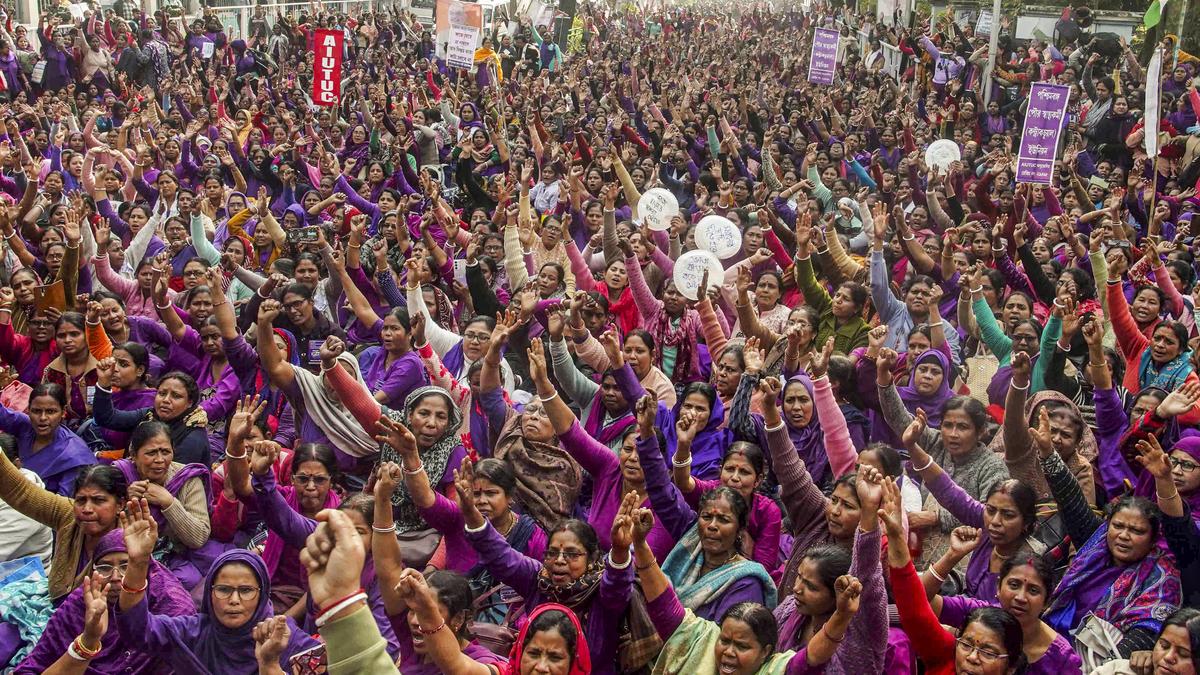
Governments must guarantee fair and equal wages for ASHA workers.
Introduction
The persistent protests by ASHA and anganwadi workers underscore India’s failure to recognise their indispensable role in public health and welfare delivery. Despite being central to flagship schemes, these workers remain trapped in precarious employment, denied fair wages, social security, and legal recognition, revealing a deep erosion of the social contract.
Background of the Protests
The ongoing protests by ASHA and anganwadi workers in West Bengal demanding a monthly wage of ₹15,000highlight the long-standing denial of permanent employee status, despite their crucial role in national and State welfare schemes.
These workers form the backbone of programmes related to nutrition, health, and social security, yet remain outside formal labour protections.
Historical Denial of Worker Status
Under the Indira Gandhi government, anganwadi workers were denied formal ‘worker’ status under the Integrated Child Development Scheme (ICDS), setting a precedent to bypass labour laws.
As workloads increased, a national union emerged in 1989, but the State continued to expand welfare schemes without creating permanent government jobs.
The classification of these workers as ‘scheme workers’ during the liberalisation period institutionalised insecurity.
Judicial and Policy Exclusion
The State of Karnataka vs Ameerbi (1996) tribunal ruling excluded anganwadi workers from being treated as government employees.
This exclusion persisted even as the right to food was expanded in 2004, increasing dependence on these workers.
The ASHA programme, launched in the mid-2000s, followed a similar path, branding workers as ‘activists’ rather than employees.
Ignored Recommendations and Budget Cuts
In the 2010s, the 45th Labour Conference recommended job regularisation, minimum wages, pensions, and gratuity for ASHA workers.
Both UPA and NDA governments failed to implement these recommendations.
In 2015, the ICDS budget was slashed, triggering recurring protests as workers struggled to meet basic needs.
Centre–State Fiscal Imbalance
The Centre froze its contribution to ASHA and anganwadi wages in 2018, forcing workers to bear the brunt of fiscal pressures.
With central honoraria stagnating, States were compelled to supplement wages from their own budgets.
Wealthier States or those facing strong union pressure managed to provide better pay or benefits, while fiscally weaker States lagged behind, deepening regional inequality.
Erosion of the Social Contract
Alongside weak protections for gig workers under new labour codes, the State has effectively retreated from its social contract with vulnerable workers.
Policy priorities have shifted towards business metrics and fiscal headroom, often at the cost of labour welfare.
The continued denial of rightful status to ASHA and anganwadi workers remains knowingly exploitative and unjust.
The Way Forward
The Centre must legally reclassify these so-called ‘volunteers’ as statutory employees under the Code on Social Security.
This reclassification should guarantee minimum wages, pension coverage, and social security.
Both the Centre and States must bridge fiscal gaps to ensure equitable pay across regions.
Only through institutionalised protections can India restore dignity, fairness, and justice to these essential workers.
Conclusion
Continued denial of statutory status to ASHA and anganwadi workers is both unjust and exploitative. The Centre and States must ensure legal reclassification, minimum wages, and pension coverage under the Code on Social Security. Only through institutionalised protections can India uphold dignity, equity, and labour justice for its essential workforce.
Editorial 2: India and the EU — a fit partnership in a divided world
Context
The two sides have the capacity to shape a new phase of multilateral cooperation.
Introduction
In geopolitics, moments of clarity are uncommon, but when they emerge, they call for decisive engagement. Such a moment is evident in the strengthening partnership between the European Union and India, as New Delhi prepares to host Ursula von der Leyen and António Luís Santos da Costa. Their role as chief guests at India’s 77th Republic Dayon January 26, 2026, followed by their co-chairing of the India–EU Summit on January 27, goes well beyond symbolism. It signals a convergence of strategic intent. The image of EU leaders standing alongside Narendra Modi at India’s most iconic national celebration will highlight not just partnership, but the urgency and significance of this evolving relationship.
India at a Strategic Crossroads
Once confident of its rapport with Donald Trump, India now finds itself in America’s crosshairs, facing punitive tariffs and hostile rhetoric.
This includes the farcical accusation of “Modi’s War” in Ukraine, linked to India’s energy purchases from Russia.
New Delhi has firmly rejected these claims as “inaccurate and misleading”, warning against double standards in global conduct.
At the same time, India maintains that the bilateral partnership has endured multiple difficult transitions and will continue on the basis of mutual respect and shared interests.
Europe understands this rupture well, reinforcing a stark reality: alliances no longer ensure protection, and strategic autonomy must now take precedence over strategic patience.
A Relationship with Potential
For years, the India–EU relationship has been marked by untapped promise, with ambitions exceeding actual outcomes.
While both sides have repeatedly pledged to deepen engagement, progress has remained uneven and intermittent.
The partnership has frequently been sidetracked by competing narratives on Russia and China, as well as by each side’s greater preoccupation with ties to the United States.
However, the renewed urgency surrounding this visit signals a possible inflection point, one that could finally translate long-standing potential into relationship-defining outcomes.
Trade, Growth and Climate Equity
India and the European Union are in the final stages of negotiating a Free Trade Agreement (FTA) that has moved slowly since 2007, but now carries clear geopolitical significance.
If fully realised, the FTA could unlock major gains across textiles and apparel through tariff reductions, pharmaceuticals and chemicals where India’s competitiveness aligns with European demand, and automobiles and machinery where Europe seeks deeper access to India’s expanding market.
Digital trade and services also stand to benefit, as regulatory harmonisation could significantly boost India’s IT and services sector.
For India, the agreement is equally about climate equity, with concerns centred on the EU’s Carbon Border Adjustment Mechanism (CBAM), which imposes a 20–35% effective carbon charge on key exports such as steel, aluminium, cement and fertilisers.
India views CBAM as a non-tariff barrier that could undermine FTA gains, making it imperative for Europe to offer meaningful relief while keeping climate commitments intact.
Security, Defence and Strategic Convergence
Beyond trade and technology, the most challenging yet critical dialogue lies in defence cooperation.
Ursula von der Leyen has proposed a Security and Defence Partnership with India, comparable to the EU’s ties with Japan and South Korea.
For the EU, such a partnership would open doors to India’s defence market and enable co-production of defence equipment.
For India, it complements Narendra Modi’s Make in India initiative, strengthening domestic manufacturing while providing access to advanced European technology.
It would also create a framework for joint military exercises and closer coordination in the Indian Ocean, reinforcing shared strategic interests in a volatile region.
As a Template for the World
At a strategic level, the India–EU partnership has the potential to serve as a global model for countries recalibrating their foreign policies and seeking new, reliable partners.
In an era marked by America’s unpredictability and China’s sustained assertiveness, India and the European Union can demonstrate a form of relationship-building that respects domestic sensitivities while embracing flexibility and pragmatism.
Central to this alignment is a shared conviction that sovereign choices must remain sovereign, and that neither China, Russia, nor the United States should exercise veto power over Indian or European strategic decisions.
Both India and Europe have borne the costs of over-dependence—on Russian energy, Chinese markets, or American security guarantees.
This shared experience has reinforced the importance of strategic autonomy, understood as expanding policy flexibility, reducing over-exposure to specific partners, and amplifying each other’s influence on the global stage.
Conclusion
India and the European Union possess the credibility, capability, and capital to jointly shape a renewed chapter in multilateralism. If both sides move decisively and steer clear of the constraints imposed by internal bureaucratic inertia, they can translate this moment of convergence into lasting impact. Together, India and the EU have the potential to advance a multipolar global order that is resilient, equitable, and firmly anchored in sovereign decision-making.
