
13 February 2026 Indian Express Editorial
What to Read in Indian Express Editorial ( Topic and Syllabus wise)
Article 1: Will Not Let Anyone Touch Aravalli: Supreme Court
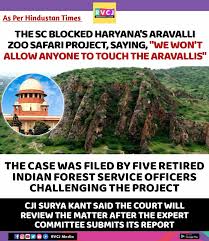
Why in News: The Supreme Court refused to allow progress on the proposed Aravalli Zoo Safari Project, asserting that no activity will be permitted until a scientific and holistic assessment of the Aravalli range is completed.
Key Details
The Supreme Court declined Haryana’s request to submit a revised DPR for the Aravalli Zoo Safari Project.
The Court emphasised that no intervention in the Aravalli range will be allowed without a scientific expert panel review.
Earlier, the Court had kept in abeyance its order accepting the 100-metre height definition of Aravalli hills.
Concerns were raised that redefining hills could open ecologically sensitive areas to mining and development.
Ecological Significance of the Aravalli Range
One of the Oldest Mountain Systems: The Aravalli range is among the oldest fold mountain systems in the world, extending across Gujarat, Rajasthan, Haryana, and Delhi. Its degradation affects a large ecological zone in north-west India.
Natural Barrier Against Desertification: The Aravallis act as a natural barrier preventing the eastward expansion of the Thar Desert. Their depletion can increase desertification risks in Haryana, Delhi, and western Uttar Pradesh.
Groundwater Recharge and Climate Regulation: The range plays a crucial role in groundwater recharge and maintaining micro-climatic balance in the NCR region. Loss of forest cover can intensify heat waves and water scarcity.
Biodiversity Hotspot: It supports diverse flora and fauna, including leopards and various endemic species. Fragmentation through mining and infrastructure threatens habitat continuity.
Legal and Constitutional Framework for Environmental Protection
Article 48A (Directive Principles): The State is mandated to protect and improve the environment and safeguard forests and wildlife.
Article 51A(g) (Fundamental Duty): Citizens have a duty to protect and improve the natural environment.
Article 21 – Right to Life: The Supreme Court has expanded Article 21 to include the right to a clean and healthy environment.
Environmental Protection Act, 1986: Provides the legal framework for environmental regulation and empowers authorities to restrict industrial and developmental activities.
Role of the Central Empowered Committee (CEC): The CEC assists the Supreme Court in forest and wildlife matters, especially in monitoring compliance with environmental norms.
Issue of Definition and Regulatory Implications
100-Metre Height Definition Controversy: A government committee proposed defining Aravalli hills as landforms with elevation of 100 metres or more above local relief. Activists argue this may exclude smaller hills from protection.
Mining Concerns: If hills below 100 metres are excluded, they may become vulnerable to mining and commercial exploitation, particularly in Haryana and Rajasthan.
Precautionary Principle: The Court’s refusal reflects the precautionary principle, which requires preventive action in the face of environmental uncertainty.
Holistic Ecosystem Approach: The Court emphasised that Aravalli does not start or end in one state; therefore, ecological decisions must consider the entire range.
Development vs Environmental Conservation Debate
Zoo Safari Project Proposal: The Haryana government reduced the proposed project area from 10,000 acres to 3,300 acres, arguing it would promote eco-tourism.
Concerns of Ecological Disturbance: Infrastructure development, roads, and tourist facilities may fragment habitats and disturb fragile ecosystems.
Sustainable Development Principle: Indian environmental jurisprudence balances economic growth with ecological preservation, ensuring that development does not compromise future generations.
Judicial Environmentalism: The Supreme Court has historically intervened in matters such as mining bans, forest conservation, and pollution control to uphold environmental rights.
Role of Judiciary in Environmental Governance
Public Interest Litigation (PIL): Environmental issues often reach the Court through PILs, reflecting judicial activism in ecological matters.
Expert-Based Decision Making: The Court’s insistence on an independent expert body highlights the need for scientific evidence in policy decisions.
Federal Environmental Governance: Since Aravalli spans multiple states, coordinated inter-state and Union-level approaches are necessary.
Judicial Oversight vs Executive Discretion: The case illustrates tensions between state development initiatives and judicial oversight for environmental protection.
Conclusion
The Aravalli issue underscores the need for a scientific, transparent, and ecosystem-based regulatory framework. Clear definitions, inter-state coordination, and strict enforcement of environmental laws are essential. Development projects must undergo rigorous Environmental Impact Assessments (EIA) and adhere to the precautionary and sustainable development principles. Protecting the Aravallis is not merely a regional concern but vital for ecological stability in northern India.
EXPECTED QUESTIONS FOR UPSC CSE
Prelims MCQ
- The precautionary principle in environmental governance implies:
(a) Development should be prioritised over conservation
(b) Preventive action should be taken even in absence of full scientific certainty
(c) Polluters should compensate affected persons
(d) Forests should be privatised
Answer: b
Descriptive Question
- Discuss the ecological significance of the Aravalli range and analyse the challenges in balancing development and environmental protection in India. (150 Words, 10 Marks)
Article 2: Parliament and the Crisis of Trust
Why in News: Recent disruptions in Parliament, including a notice of no-confidence against the Speaker and heightened confrontation between the ruling party and Opposition, highlight a deepening breakdown of trust affecting parliamentary functioning.
Key Details
118 Opposition MPs have reportedly signed a notice to move a no-confidence motion against the Lok Sabha Speaker.
Controversies surrounding debates on the Motion of Thanks and references to unpublished material have escalated tensions.
Allegations and counter-allegations between the ruling party and the Opposition have led to repeated disruptions.
The situation reflects a growing institutional strain affecting parliamentary dignity and deliberative democracy.
Parliamentary Democracy: Constitutional Foundations
Supremacy of Parliament in Law-Making: Under Articles 79–122 of the Constitution, Parliament is the supreme legislative body representing the will of the people. Its functioning is central to democratic accountability and policy-making.
Collective Responsibility & Debate: Article 75 establishes collective responsibility of the Council of Ministers to the Lok Sabha, which can function meaningfully only if debates, questioning, and scrutiny occur.
Role of the Opposition: Though not explicitly mentioned in the Constitution, the Opposition is institutionally recognised (Leader of Opposition Act, 1977) as essential for accountability and checks on executive power.
Deliberative Democracy: The Constituent Assembly envisioned Parliament as a forum of reasoned discussion, not mere majoritarian assertion. Debate, dissent, and compromise are intrinsic to parliamentary culture.
Breakdown of Trust: Contemporary Manifestations
Frequent Disruptions: Recent sessions have witnessed adjournments, protests in the Well of the House, and reduced legislative debate time, impacting productivity.
No-Confidence Notice Against Speaker: A motion against the Speaker raises serious institutional questions, as the Speaker is expected to function with neutrality and moral authority.
Politicisation of Security and Proceedings: Statements regarding security concerns inside the House and disputes over parliamentary conduct have intensified mistrust between the two sides.
Escalation of Rhetoric: Substantive motions and allegations against key constitutional functionaries reflect a shift from policy disagreement to institutional confrontation.
Office of the Speaker & Institutional Neutrality
Constitutional Position (Article 93): The Speaker is elected by the House and is expected to act impartially, rising above party lines once in office.
Guardian of Parliamentary Privileges: The Speaker regulates debates, decides on points of order, and adjudicates disqualification under the Tenth Schedule.
Moral Authority & Precedent: Historically, Speakers commanded respect across parties, facilitating dialogue during crises through behind-the-scenes consultations.
Perception vs. Legitimacy: Even perception of bias can weaken institutional credibility, underscoring the importance of transparency and neutrality.
Historical Perspective: Disruptions Are Not New
Coalition Era (1989–2014): Frequent disruptions occurred during coalition politics, often reflecting regional and ideological contestations.
Lokpal Bill Episode (2011): The tearing of the Bill in the Rajya Sabha symbolised intense political disagreement, yet institutional dialogue eventually continued.
Presidential Concerns: In 2016, President Pranab Mukherjee publicly urged MPs to fulfil their legislative duties, signalling concern over declining standards.
Continuity & Change: While disruptions have historical precedent, the present intensity suggests a deeper erosion of trust rather than episodic protest.
Opposition as ‘Opponent, Not Enemy’
Sushma Swaraj’s Democratic Ethos: In her 2014 farewell speech in the Lok Sabha, she emphasised that political actors are “opponents, not enemies,” highlighting civility in disagreement.
Constructive Dissent: Parliamentary democracy requires institutionalised opposition to critique policy without undermining constitutional legitimacy.
Adversarial but Cooperative Model: India follows the Westminster system, where government and opposition contest policy but cooperate to maintain institutional functioning.
Erosion of Civility: Increasing personalisation of politics and public rhetoric risks transforming adversarial politics into antagonistic confrontation.
Consequences of Parliamentary Dysfunction
Reduced Legislative Scrutiny: Bills passed without adequate discussion weaken democratic deliberation and reduce transparency.
Weakening of Committees: Parliamentary committees, traditionally spaces of bipartisan consensus, lose relevance if political polarisation deepens.
Public Disillusionment: Dysfunctional proceedings can erode citizens’ trust in representative institutions.
Institutional Precedent: Normalising disruption may create long-term damage to parliamentary conventions and norms.
Conclusion
Restoring parliamentary functionality requires rebuilding trust between the ruling side and the Opposition. Institutional neutrality of the Speaker, structured dialogue mechanisms, strengthening of committee systems, and adherence to parliamentary ethics are crucial. Democratic politics is inherently adversarial, but it must remain constitutional and civil. Reviving the spirit articulated by Sushma Swaraj—that opponents are not enemies—is essential to preserve the dignity and vitality of India’s parliamentary democracy.
EXPECTED QUESTIONS FOR UPSC CSE
Prelims MCQ
- The Leader of Opposition in India is officially recognised under which Act?
(a) Representation of the People Act
(b) Parliament (Prevention of Disqualification) Act
(c) Salary and Allowances of Leaders of Opposition Act, 1977
(d) Anti-Defection Act
Answer: (c)
Descriptive Question
- Examine the role of the Speaker in maintaining neutrality and ensuring smooth functioning of the House. Suggest reforms to strengthen institutional credibility. (250 Words, 15 Marks)
Article 3: WHO Needs a Financial Model Less Vulnerable
Why in News: The withdrawal of the United States from the World Health Organization (WHO) has created a significant funding shortfall, raising concerns about the sustainability of global health governance.
Key Details
The US exit has reduced WHO’s 2026–27 budget by nearly $4 billion, creating an estimated 15% funding gap.
WHO has announced a “reset” of priorities, focusing on life-saving services and scaling back lower-impact programmes.
Structural reforms include merging departments, halving director-level posts, and potential workforce cuts of over 7,000 staff.
The crisis has reignited debate on creating a resilient and predictable financial model for global health governance.
WHO: Mandate and Global Role
Specialised UN Agency (1948): The World Health Organization was established in 1948 with the objective of attaining the highest possible level of health for all people, making health a global public good.
Norm-setting Authority: WHO develops international health regulations, disease classification systems, and global health standards such as the International Health Regulations (2005).
Emergency Response Leadership: It coordinates responses to pandemics (COVID-19), Ebola outbreaks, and polio eradication efforts, providing technical expertise and logistical coordination.
Support to Developing Countries: Many low- and middle-income countries depend on WHO for immunisation support, maternal health programmes, and disease surveillance systems.
Funding Structure and Vulnerabilities
Assessed vs Voluntary Contributions: WHO’s budget is financed through assessed contributions (mandatory membership fees) and voluntary contributions from countries and private donors. Over 70% of funding comes from voluntary sources.
Dependence on Major Donors: The United States has historically been the largest contributor, making WHO vulnerable to geopolitical shifts.
Earmarked Funding Problem: Most voluntary funds are earmarked for specific projects, reducing WHO’s flexibility to allocate resources based on emerging priorities.
Budgetary Uncertainty: The recent US withdrawal has reduced the 2026–27 budget by around $4 billion, compelling the agency to restructure operations.
Impact of the Financial Crunch
Programme Rationalisation: WHO has indicated it will focus on “life-saving services” and scale back “lower-impact services,” potentially affecting long-term health system strengthening.
Workforce Reduction: Planned restructuring may reduce staff strength by more than 7,000 personnel, limiting technical assistance to member states.
Impact on Conflict Zones: Health responses in fragile regions such as Gaza and Sudan may suffer due to resource constraints.
Immunisation and Outbreak Response: Funding shortages could disrupt vaccination drives and weaken preparedness against infectious disease outbreaks in vulnerable regions.
Global Health Governance as a Public Good
Health as a Global Public Good: Infectious diseases do not respect national boundaries, making global health governance essential for collective security.
Lessons from COVID-19: The pandemic exposed weaknesses in international coordination and underscored the importance of strong multilateral institutions.
Need for Financial Stability: Political unpredictability should not determine the functioning of an agency responsible for global disease surveillance and response.
Equity and Access: WHO plays a crucial role in promoting equitable access to vaccines, medicines, and health technologies, especially in the Global South.
India’s Perspective and Multilateralism
India as a Responsible Stakeholder: India has consistently supported multilateral health initiatives and advocated for equitable vaccine distribution.
Domestic Experience: India’s success in large-scale immunisation and digital health initiatives can inform global health governance reforms.
Global South Leadership: As a voice of developing nations, India can advocate for a more democratic and predictable financing framework.
Alignment with SDG 3: Sustainable Development Goal 3 (Good Health and Well-being) requires a stable and adequately funded WHO.
Conclusion
The current funding crisis presents an opportunity to rethink the financial architecture of global health governance. A resilient WHO requires:
Increasing the share of assessed contributions to reduce overdependence on voluntary funding.
Creating a global health contingency fund insulated from geopolitical volatility.
Promoting diversified donor participation, including emerging economies.
Strengthening transparency and accountability to build donor confidence.
A stable and predictable financial model is essential to ensure that global health remains insulated from political fluctuations. In an interconnected world, weakening WHO would undermine collective health security. Strengthening its financial resilience is not merely an institutional reform but a global necessity.
EXPECTED QUESTION FOR UPSC CSE
Prelims MCQ
- With reference to the World Health Organization (WHO), consider the following statements:
It was established in 1948 as a specialised agency of the United Nations.
Its funding is entirely based on mandatory contributions from member states.
It plays a role in coordinating international responses to health emergencies.
Which of the statements given above are correct?
(a) 1 and 3 only
(b) 2 and 3 only
(c) 1 and 2 only
(d) 1, 2 and 3
Answer: (a)
