

A Step-by-Step Guide To Understanding The GMAT Exam Format
If you’re planning to take the GMAT, the first and most important step is to clearly understand the exam format. Many aspirants jump straight into preparation without fully knowing the structure of the test, which often leads to confusion and poor time management.
This guide will walk you through the GMAT exam format step by step, helping you build a strong foundation for your preparation.
What is the GMAT?
The Graduate Management Admission Test (GMAT) is a standardized exam used by business schools worldwide for admission into MBA and other management programs. It evaluates your skills in:
- Analytical thinking
- Quantitative reasoning
- Verbal reasoning
- Data analysis
Overview of the GMAT Exam Structure
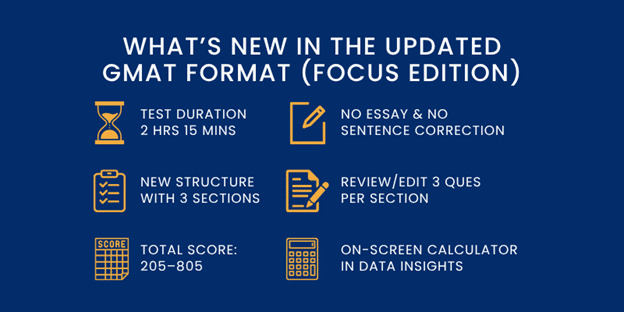
The GMAT consists of four main sections:
- Analytical Writing Assessment (AWA)
- Integrated Reasoning (IR)
- Quantitative Reasoning
- Verbal Reasoning
Total Duration:
- Approximately 3 hours 30 minutes (including optional breaks)
Step 1: Analytical Writing Assessment (AWA)
Duration:
- 30 minutes
What You Need to Do:
- Write an essay analyzing an argument
What is Tested:
- Critical thinking
- Ability to evaluate arguments
- Clarity of expression
Key Tip:
Focus on analyzing the logic, not giving your personal opinion.
Step 2: Integrated Reasoning (IR)
Duration:
- 30 minutes
- 12 questions
Question Types:
- Multi-source reasoning
- Table analysis
- Graphics interpretation
- Two-part analysis
Skills Tested:
- Data interpretation
- Logical reasoning
- Ability to analyze multiple data sources
Step 3: Quantitative Reasoning
Duration:
- 62 minutes
- 31 questions
Question Types:
- Problem Solving
- Data Sufficiency
Skills Tested:
- Mathematical reasoning
- Problem-solving ability
Step 4: Verbal Reasoning
Duration:
- 65 minutes
- 36 questions
Question Types:
- Reading Comprehension
- Critical Reasoning
- Sentence Correction
Skills Tested:
- Reading ability
- Logical reasoning
- Grammar and language skills
Section Order Flexibility
One unique feature of the GMAT is that you can choose the order of sections.
Common Options:
- AWA → IR → Quant → Verbal
- Verbal → Quant → IR → AWA
- Quant → Verbal → IR → AWA
Strategy:
Pick an order that suits your strengths. For example:
- Strong in math? Start with Quant
- Strong in language? Start with Verbal
Scoring System Explained
Total Score:
- Ranges from 200 to 800
Section-wise Scores:
- Quantitative: 6–51
- Verbal: 6–51
- Integrated Reasoning: 1–8
- AWA: 0–6
Important Note:
- The total score is mainly based on Quant and Verbal sections
Adaptive Nature of the GMAT
The GMAT is a computer-adaptive test (CAT).
What This Means:
- The difficulty of questions changes based on your performance
- Correct answers → harder questions
- Incorrect answers → easier questions
Key Strategy:
- Maintain consistency
- Avoid careless mistakes early in the test
Optional Breaks
You get:
- Two optional breaks of 8 minutes each
When They Occur:
- Between sections
Tip:
Use breaks wisely to:
- Relax
- Hydrate
- Refocus
Online vs Test Center GMAT
You can take the GMAT:
- At a test center, or
- Online from home
Differences:
- Online version may have slight variations in format
- Test center offers a controlled environment
Choose based on your comfort level.
Key Rules to Remember
- No skipping questions
- No returning to previous questions
- Time management is critical
- Each question carries importance
Common Mistakes to Avoid
- Not understanding the exam format
- Ignoring weaker sections
- Spending too much time on one question
- Poor time management
Step-by-Step Preparation Strategy Based on Format
- Understand all sections clearly
- Identify your strengths and weaknesses
- Choose the best section order
- Practice each section individually
- Take full-length mock tests
- Analyze performance and improve
Final Tips for Success
- Familiarity with the format reduces anxiety
- Practice under timed conditions
- Focus on accuracy and consistency
- Stay calm during the exam
Conclusion
Understanding the GMAT exam format is the foundation of your preparation journey. Once you know what to expect, you can plan your strategy more effectively and approach the exam with confidence.
By mastering the structure, timing, and scoring system, you put yourself in a strong position to achieve a high score.
Start with clarity, practice consistently, and success will follow.
