

How To Approach Inequality And Coding-Decoding Questions
HOW TO APPROACH INEQUALITY AND CODING-DECODING QUESTIONS
Mastering Inequality & Coding-Decoding for Bank Exams
Inequality and Coding-Decoding are high-scoring topics in banking exams (IBPS PO, SBI Clerk, RBI Assistant). These questions test logical reasoning and pattern recognition skills. Below is a detailed guide to solving them efficiently.
1. Inequality Questions
Inequality questions involve mathematical symbols (>, <, ≥, ≤, =, ≠) to compare variables.
Types of Inequality Problems
Direct Inequalities (e.g., A > B ≥ C)
Coded Inequalities (Symbols represent relations, e.g., @ means >)
Combined Inequalities (Multiple statements with conclusions)
KEY RULES & CONCEPTS
✔ Priority Order: > ≥ = ≤ < (Strongest to weakest)
✔ Transitive Property:
If A > B and B > C → A > C.
✔ Either-Or Cases:
“A ≥ B” means “A > B or A = B” (at least one must be true).
✔ No Relation Rule:
If two variables are not directly/indirectly linked → No conclusion.
Step-by-Step Solving Approach
Decode Symbols (if coded).
Draw a Relationship Tree (A → B → C).
Check Conclusions using the tree.
Example (Direct Inequality)
Statements:
P ≥ Q = R < S ≤ T
Conclusions:
P > R
T > Q
Solution:
P ≥ Q = R → P ≥ R (Conclusion 1: Maybe, since P could be = R).
Q = R < S ≤ T → Q < T (Conclusion 2: True).
2. Coding-Decoding Questions
Coding-Decoding involves converting words/numbers into patterns.
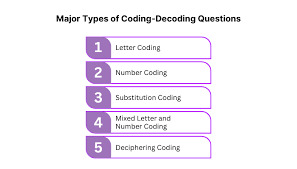
Types of Coding-Decoding Problems
Letter Shifting (A → C, B → D, etc.)
Symbol-Based Coding (e.g., DOG = %#@)
Number Coding (CAT = 312)
Fictitious Language (New coding rules given)
Key Strategies
✔ Look for Alphabet Positions (A=1, B=2… Z=26).
✔ Identify Forward/Backward Shifts (A → C = +2 shift).
✔ Check Reverse Letter Pairs (A ↔ Z, B ↔ Y).
✔ Spot Repeated Patterns (e.g., “APPLE” → 1-16-16-12-5).
Step-by-Step Solving Approach
Find the Base Word (e.g., “CAT” is often used in examples).
Compare Letter Positions between coded & original words.
Apply the Rule to the target word.
Example (Letter Shifting)
Question:
If “CODE” is written as “EQFG,” how is “BANK” written?
Solution:
C (+2) → E
O (+2) → Q
D (+2) → F
E (+2) → G
Apply +2 shift: B→D, A→C, N→P, K→M → DCPM
3. Common Mistakes & How to Avoid Them
❌ Ignoring Transitive Property → Leads to wrong inequality conclusions.
❌ Overcomplicating Coding → Stick to simple shifts first.
❌ Missing Either-Or Cases → “A ≥ B” has two possibilities.
❌ Skipping Reverse Coding → Check if letters are reversed (e.g., “RAT” = “TAR”).
4. Best Books & Practice Resources
📚 “Verbal & Non-Verbal Reasoning” – Magme Medal
📚 “Logical Reasoning” – Magme Medal
📚 Previous Year Papers (IBPS/SBI/RBI)
📚 Online Mock Tests (Magme Medal)
5. Final Tips for High Accuracy
✅ Practice 10-15 questions daily (Mix of Inequality & Coding).
✅ Use quick notations (e.g., A>B>C for inequalities).
✅ Memorize alphabet positions (A=1, B=2… Z=26).
✅ Solve timed quizzes to improve speed.
Conclusion
Inequality: Use transitive logic and relationship trees.
Coding-Decoding: Look for letter shifts and patterns.
Avoid assumptions, practice regularly, and take timed tests.
