

02 January 2026 The Hindu Editorial
What to Read in The Hindu Editorial( Topic and Syllabus wise)
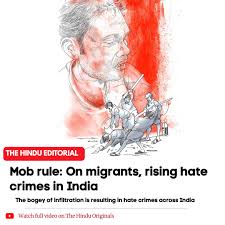
Editorial 1: Mob rule
Context
The manufactured narrative of “infiltration” is fueling xenophobia and triggering hate crimes across India.
Introduction
In the closing weeks of 2025, India witnessed a disturbing surge in mob violence against migrant workers, driven by xenophobic suspicion over language and identity. Ordinary citizens were falsely labelled as foreigners, exposing deep anxieties around belonging, citizenship, and the erosion of rule of law.
Rising Pattern of Mob Violence Against Migrants
In the closing weeks of 2025, multiple incidents across India revealed a disturbing trend of mob attacks on migrants
Victims were wrongly branded as “Bangladeshi” or “Chinese”, despite being Indian citizens
Suspicion based on language, region, appearance, or presumed nationality is increasingly turning into violent vigilantism
This trend poses a serious threat to social cohesion and constitutional values
Shocking Incidents Across States
In Kerala’s Palakkad district, Ram Narayan Baghel, a migrant worker from Chhattisgarh, was lynched on December 17 after being accused of theft and questioned about being “Bangladeshi”
In Sambalpur, Odisha, Juel Sheikh, a daily wage labourer from West Bengal, was beaten to death on December 24 after being asked to prove his identity at a tea stall
Another Bengali-speaking street vendor from West Bengal was assaulted in Odisha days later, showing a pattern rather than an isolated act
Targeting of Northeastern and Migrant Communities
In Tamil Nadu’s Tiruvallur district, a man from Odisha was attacked on a train by juveniles with machetes and sickles, with the assault circulated on social media
In Dehradun, Anjel Chakma, a 22-year-old student from Tripura, was stabbed to death on December 28 after being subjected to racial slurs
People from the Northeastern States continue to be treated as perpetual outsiders, often stereotyped as “Chinese”
Institutional and Political Responsibility
These incidents occur amid wider mob intimidation, sometimes against minority worshippers or even students in public spaces
While police arrests have been made, strict enforcement and deterrence are still lacking
The Bharatiya Janata Party has foregrounded the issue of “illegal infiltration” from Bangladesh in election campaigns in Assam and West Bengal
Such rhetoric risks emboldening mobs, and political leadership at both the State and Union levels must clearly condemn and restrain narratives that legitimise violence
Conclusion
These incidents underline an urgent need for firm policing, political restraint, and an unequivocal defence of constitutional equality. Normalising rhetoric around “illegal infiltration” risks legitimising violence against the vulnerable. India’s strength lies in its diversity, and safeguarding human dignity must remain a non-negotiable responsibility of the State.
Editorial 2: The water divide
Context
The quality of piped water supply must be rigorously tested at the point of delivery to ensure it is safe for consumption.
Introduction
Public health reflects the State’s commitment to basic human needs, especially for the poor and vulnerable. Recent tragedies linked to contaminated drinking water expose serious failures in governance, infrastructure, and regulatory oversight, showing that access without quality assurance can turn essential services into public health hazards.
Public Health and Basic Needs
Public health is best measured by the well-being of the poor and vulnerable
Safe water, healthcare, education, infrastructure, and clean air are basic necessities, not privileges
Institutions must work continuously and proactively to protect citizens’ lives
India is falling short on several of these critical indicators
Indore Tragedy and Administrative Failure
In Indore, Madhya Pradesh, at least four people (including a baby) died after consuming municipality-supplied contaminated water
Over 2,000 people fell ill, with 200+ hospitalised and 32 in ICU
The incident is deeply ironic, as Indore has repeatedly been ranked India’s cleanest city
Post-crisis blame-shifting and committees cannot excuse the failure to prevent the disaster
Recurring Water Contamination in Madhya Pradesh
This is the second major water-related crisis in the State within two months
In November, students at a Vellore Institute of Technology campus near Bhopal protested after jaundice outbreaks due to contaminated water
Such repeated incidents indicate systemic lapses, not isolated accidents
Early detection and public warnings could have prevented loss of life
Policy Gaps and the Way Forward
Despite progress under Swachh Bharat Mission and Jal Jeevan Mission, water safety failures persist
Access to water is meaningless without assured quality and monitoring
Old pipelines, sewage leaks, and chemical contamination must be urgently addressed
States must enforce strict water-quality norms, upgrade infrastructure, and run public awareness campaigns
With a population nearing 147 crore, unsafe water poses a grave national health risk
Conclusion
The recurring water contamination crises demand urgent systemic reform, not post-disaster blame. Ensuring safe drinking water, enforcing strict standards, upgrading aging infrastructure, and strengthening monitoring mechanisms are non-negotiable. Without decisive action, preventable deaths will continue to undermine citizen trust and India’s public health goals.
