
04 February 2026 Indian Express Editorial
What to Read in Indian Express Editorial ( Topic and Syllabus wise)
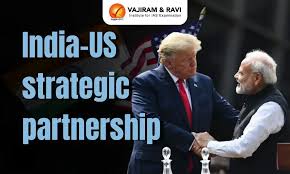
Article 1: India–US Strategic Partnership
Why in News: The recent finalisation of the India–US trade agreement has reduced tariff-related frictions and renewed momentum in the strategic partnership between the two countries.
Key Details
India and the US concluded a trade deal after prolonged negotiations marked by tariff disputes.
The agreement enables renewed focus on defence cooperation, critical technologies, and the Indo-Pacific strategy.
Strategic convergence between India and the US has remained resilient despite differences over trade, Russia, and Pakistan.
Both countries seek to counter China’s growing influence and preserve a multipolar Asian order.
India–US Trade Deal: Economic Reset
Resolution of Tariff Disputes: The trade deal has eased tariff pressures that had strained bilateral ties, enabling a shift from transactional engagement to long-term economic cooperation.
Foundation for Growth: Trade normalisation creates conditions for expanding bilateral trade, which already exceeds USD 190 billion, and for improving investment flows.
Strategic Economic Diplomacy: India adopted a calibrated approach—neither escalating nor capitulating—highlighting maturity in economic diplomacy.
Link with Strategic Agenda: Trade stability supports cooperation in defence manufacturing, technology transfer, and supply-chain resilience.
Structural Strength of India–US Relations
Strategic Convergence: Over the last two decades, India and the US have built a dense architecture of cooperation through defence agreements, dialogues, and institutional mechanisms.
Beyond Leadership Personalities: The partnership is driven by shared interests rather than individual leaders, making it resilient to political or policy shifts.
Multi-Domain Engagement: Cooperation spans defence, space, cyber security, critical minerals, and emerging technologies.
Indo-Pacific Centrality: Both countries view a free, open, and inclusive Indo-Pacific as central to regional stability.
Role of Pakistan and Russia: Limited Disruptors
Pakistan’s Diminished Strategic Weight: While Pakistan retains tactical relevance for the US, it no longer enjoys strategic parity with India due to widening economic and geopolitical gaps.
End of Hyphenation: India–US relations are no longer framed through a Pakistan-centric lens, reflecting India’s enhanced global stature.
India–Russia Engagement: India’s energy imports from Russia are driven by market considerations rather than strategic alignment.
Strategic Autonomy Maintained: India balances ties with Russia without allowing them to undermine its deepening partnership with the US.
China Factor and Indo-Pacific Strategy
Primary Strategic Variable: China’s rapid economic and military rise remains the central concern shaping India–US strategic alignment.
Shared Objective: Both countries seek to prevent the domination of the Indo-Pacific by any single power, aligning with the idea of multipolar Asia.
US Strategic Documents: Recent US security strategies prioritise balancing China, which complements India’s regional interests.
India’s China Recalibration: India’s approach towards China reflects realism, combining competition with selective engagement.
Burden Sharing and Regional Responsibility
Shift in US Expectations: The US increasingly expects partners to assume greater responsibility for regional stability.
Opportunity for India: This creates strategic space for India to play a larger role in South Asia and the Indian Ocean Region (IOR).
From Dependence to Partnership: India is moving from security dependence to a co-shaping role in regional order.
Proactive Regional Strategy: India must leverage US convergence to strengthen national capabilities and regional influence.
India’s Westward Economic Orientation
Trade Policy Transition: India is shifting from defensive trade policies to deeper integration with Western economies.
Complementary Economies: Stronger ties with the US, EU, and Anglosphere countries support India’s growth and technological modernisation.
Capital and Technology Access: Western markets and investments are critical for India’s manufacturing, digital, and clean energy ambitions.
Strategic Economic Logic: Economic prosperity and geopolitical influence are increasingly interconnected.
Conclusion
With tariff-related tensions easing, India and the US are well-positioned to deepen a partnership that shapes the balance of power in Asia and beyond. To realise this potential, both countries must institutionalise trade commitments, expand defence and technology collaboration, and coordinate regional strategies. A stable, multipolar Indo-Pacific anchored in economic interdependence and strategic trust remains the shared objective.
EXPECTED QUESTION FOR UPSC CSE
Prelims MCQ
- The recent India–US trade agreement is significant primarily because it:
(a) Ends strategic competition between the two countries
(b) Resolves all geopolitical differences
(c) Reduces tariff-related frictions and enables broader cooperation
(d) Aligns India fully with US foreign policy
Answer: (c)
Article 2: Frozen Embryo Donation
Why in News: The Delhi High Court has issued notice on a PIL challenging provisions of the Assisted Reproductive Technology (Regulation) Act, 2021, which prohibit the donation of surplus frozen embryos for reproductive use.
Key Details
The PIL questions mandatory destruction of viable frozen embryos despite mutual consent of donor and recipient couples.
The ART Act, 2021 permits sperm and egg donation but bars embryo donation for reproductive purposes.
Infertility affects 27–30 million couples in India, making IVF and ART a significant public health issue.
The plea invokes Articles 14 and 21 of the Constitution, alleging arbitrariness and violation of decisional autonomy.
Assisted Reproductive Technology (ART): Concept and Evolution
Meaning of ART: Assisted Reproductive Technology refers to medical procedures such as IVF, ICSI, and gamete donation that help individuals or couples achieve pregnancy when natural conception is not possible.
Growth of ART in India: India has emerged as a major ART destination due to rising infertility, delayed marriages, lifestyle diseases, and medical tourism.
Ethical and Regulatory Need: Absence of regulation earlier led to exploitation, unregulated clinics, and commodification of reproduction, necessitating statutory control.
International Practice: Countries like the UK, Australia, and parts of the EU permit embryo donation under strict ethical and consent-based frameworks.
Assisted Reproductive Technology (Regulation) Act, 2021: Key Provisions
Regulation of Clinics and Banks: The Act mandates registration of ART clinics and gamete banks, ensuring standardisation and accountability.
Permitted Donations: Altruistic donation of sperm and oocytes is allowed, including “double donor IVF”, where neither parent has a genetic link to the child.
Embryo Storage Rules: Surplus embryos may be cryopreserved for up to 10 years, after which they must be destroyed or donated for research.
Prohibition on Embryo Donation: Clinics are barred from transferring frozen embryos to another couple for reproductive use, even with informed consent.
Frozen Embryos and IVF Practice: Medical Perspective
Creation of Surplus Embryos: IVF cycles often generate multiple embryos to improve success rates; not all are implanted.
Medical Equivalence: Frozen embryos, once thawed, are biologically equivalent to fresh embryos and are routinely used worldwide.
Cost and Accessibility: IVF is expensive and requires multiple cycles, making embryo donation a potentially affordable alternative for infertile couples.
Current Legal Constraint: Despite medical feasibility, Indian law treats frozen embryos as non-transferable for reproductive purposes.
Constitutional Issues Raised by the PIL
Article 14 – Right to Equality: The plea argues that allowing fresh donor embryos but prohibiting frozen embryo donation creates an arbitrary classification.
Article 21 – Personal Liberty: Reproductive choice, including decisions on parenthood through ART, falls within decisional autonomy protected under Article 21.
Double Standard Argument: Genetic non-linearity is legally accepted in fresh donor IVF but rejected once embryos are frozen, despite biological similarity.
Judicial Scrutiny: The Delhi High Court is examining whether such differentiation is constitutionally reasonable.
Ethical and Social Dimensions
Destruction vs Donation: Mandating destruction of viable embryos while barring donation raises ethical concerns regarding wastage of life potential.
Infertility as a Public Health Issue: With millions affected, embryo donation could widen reproductive options, especially for women unable to produce viable eggs.
Equity Concerns: Wealthier couples may seek embryo donation abroad, while others remain constrained, deepening inequality.
Consent-Based Ethics: The challenge emphasises voluntary, altruistic, and fully informed consent from both donor and recipient couples.
State Regulation vs Individual Autonomy
Justification for Regulation: The state seeks to prevent misuse, commercialisation, and ethical violations in reproductive technology.
Limits of Paternalism: Excessive restriction may undermine reproductive freedom and personal dignity.
Balancing Test: The issue reflects the broader constitutional balance between state interest, morality, and individual liberty.
Judicial Role: Courts often act as arbiters when statutory frameworks lag behind technological and social realities.
Conclusion
The frozen embryo donation debate highlights the tension between technological advancement and regulatory conservatism. A nuanced policy framework allowing strictly regulated, consent-based embryo donation could balance ethical safeguards with reproductive rights. Legislative reconsideration, guided by constitutional values, medical science, and social equity, is essential to ensure that ART law remains humane, rational, and inclusive. The case underscores the need for laws to evolve with changing realities while upholding dignity and choice.
Article 3: Iran–US Talks Amid Escalating Tensions
Why in News: Iran’s President Masoud Pezeshkian has signalled willingness for “fair and equitable negotiations” with the United States amid rising West Asian tensions, while Washington has not yet confirmed talks.
Key Details
Iran’s reformist President has instructed the Foreign Minister to pursue negotiations with the US under suitable conditions.
The move reportedly has backing from Iran’s Supreme Leader, marking a significant political shift.
The US has linked any talks to Iran’s nuclear programme, amid recent military escalations.
Regional actors such as Türkiye and Pakistan are emerging as potential facilitators.
Background of Iran–US Relations
Post-1979 Hostility: Diplomatic relations between Iran and the US broke down after the Iranian Revolution (1979), leading to decades of sanctions, mistrust, and strategic rivalry.
Nuclear Issue as Core Dispute: Iran’s nuclear programme has been the central point of tension, culminating in the JCPOA (2015), from which the US withdrew in 2018.
Sanctions and Economic Pressure: US-led sanctions have severely impacted Iran’s economy, affecting oil exports, currency value, and public welfare.
Recurring Cycles of Escalation: Periodic military incidents, cyberattacks, and proxy conflicts in West Asia have repeatedly derailed diplomatic efforts.
Significance of Pezeshkian’s Statement
Shift in Iranian Political Messaging: The call for “fair and equitable negotiations” marks a departure from earlier hardline rhetoric, indicating a pragmatic approach.
Supreme Leader’s Implicit Approval: Support from Ayatollah Khamenei is crucial, as the Supreme Leader holds decisive authority over foreign and security policy.
Domestic Context: The move follows nationwide protests and internal instability, suggesting diplomacy as a tool to ease external pressure.
Conditional Engagement: Iran has stressed negotiations must be free from threats and excessive demands, reflecting concerns over sovereignty and dignity.
US Position and Strategic Calculations
Uncertainty over Talks: The US has not formally confirmed negotiations, indicating cautious diplomacy amid domestic and strategic constraints.
Nuclear Conditionality: Washington has linked talks to curbs on Iran’s nuclear programme, including enrichment levels and inspections.
Military Posture in the Region: Incidents such as the shooting down of an Iranian drone near a US aircraft carrier highlight continued security tensions.
Alliance Considerations: US policy is influenced by regional allies, particularly Israel and Gulf countries, wary of Iran’s strategic ambitions.
Role of Regional and External Actors
Turkiye as a Mediator: Turkiye’s neutral diplomatic positioning and regional influence make it a plausible venue for negotiations.
Pakistan’s Emerging Role: Pakistan’s invitation to participate reflects its growing diplomatic engagement and strategic balancing in West Asia.
Regional Stability Concerns: Countries dependent on Gulf trade routes are invested in de-escalation, especially in the Strait of Hormuz.
Multipolar Diplomacy: The involvement of multiple regional actors signals a shift from unilateral to multilateral crisis management.
Security Tensions in the Persian Gulf
Strategic Importance of Strait of Hormuz: Nearly 20% of global oil trade passes through this chokepoint, making any military incident globally significant.
Drone and Naval Incidents: The recent drone shootdown underscores risks of miscalculation in heavily militarised waters.
Proxy and Hybrid Warfare: Both sides engage indirectly through proxies, cyber operations, and economic pressure, complicating diplomacy.
Impact on Global Energy Markets: Escalation can lead to oil price volatility, affecting inflation and growth worldwide.
Implications for India
Energy Security: Stability in Iran–US relations is crucial for India’s oil imports and long-term energy diversification.
Connectivity Projects: Improved relations could revive India’s strategic interests in Chabahar Port and regional connectivity to Central Asia.
Diaspora and Trade: Millions of Indians live in the Gulf region, making regional peace a direct national interest.
Strategic Autonomy: India supports dialogue and diplomacy while maintaining balanced relations with both Iran and the US.
Way Forward
Structured and Phased Dialogue: Iran and the United States should adopt a step-by-step negotiation framework, beginning with confidence-building measures such as sanctions relief in exchange for nuclear transparency, rather than attempting a comprehensive settlement at once.
Revival of Multilateralism: Re-engaging regional and global stakeholders including the EU, UN, and regional mediators such as Turkiye and Oman can enhance legitimacy, reduce mistrust, and prevent bilateral deadlock.
De-escalation in the Persian Gulf: Both sides must prioritise military de-confliction mechanisms, including communication hotlines and adherence to international maritime norms, to avoid accidental escalation in critical waterways like the Strait of Hormuz.
Addressing Regional Security Concerns: Negotiations should gradually expand beyond the nuclear issue to include regional stability, proxy conflicts, and missile proliferation, ensuring durable peace rather than issue-specific truces.
Respect for Sovereignty and Mutual Dignity: Sustainable diplomacy requires negotiations that are free from coercion, excessive conditionality, and regime-change narratives, aligning with Iran’s demand for dignity and the US emphasis on compliance.
Role of Middle Powers: Countries such as India, Türkiye, and Pakistan can play a constructive role by supporting dialogue, humanitarian cooperation, and economic engagement without aligning exclusively with any bloc.
Long-term Economic Integration: Gradual economic normalisation through trade, investment, and energy cooperation can create stakeholder incentives for peace, reducing the likelihood of future confrontation.
Conclusion
Sustainable Iran–US engagement requires trust-building, phased negotiations, and respect for mutual security concerns. Regional mediators can play a constructive role in reducing misperceptions. Diplomacy, rather than coercion, remains the only viable path to long-term stability in West Asia, with positive spillover effects for global security and economic order.
EXPECTED QUESTIONS FOR UPSC CSE
Prelims MCQ
- The Strait of Hormuz is strategically important because it:
Connects the Red Sea to the Mediterranean
Is a major route for global oil trade
Separates the Caspian Sea from the Black Sea
Hosts permanent UN naval forces
Answer: (b)
Descriptive Question
- Discuss the strategic significance of renewed Iran–US negotiations for regional stability in West Asia.(GS 2; 150 Words, 10 Marks)
