

05 February 2026 The Hindu Editorial
What to Read in The Hindu Editorial ( Topic and Syllabus wise)
Article 1: Joining hands
Why in news: Recently President’s Rule was revoked after nearly a year, paving the way for a new BJP-led government under Yumnam Khemchand Singh. The move avoids extending President’s Rule beyond one year and comes amid continuing ethnic tensions and efforts to restore democratic governance.
Key Details
President’s Rule revoked after nearly a year, enabling the formation of a new elected government in Manipur.
Yumnam Khemchand Singh sworn in as Chief Minister, with two Deputy CMs representing Kuki-Zo and Naga groups.
Move avoided a constitutional amendment and helped the BJP project democratic governance.
Leadership change followed public discontent and electoral setbacks linked to N. Biren Singh’s tenure.
Ethnic violence and displacement persist, highlighting the need for deeper reconciliation efforts.
End of President’s Rule and New Leadership
Nearly one year after former Chief Minister N. Biren Singh’s resignation on February 9, 2025, President’s Rule was revoked by President Droupadi Murmu.
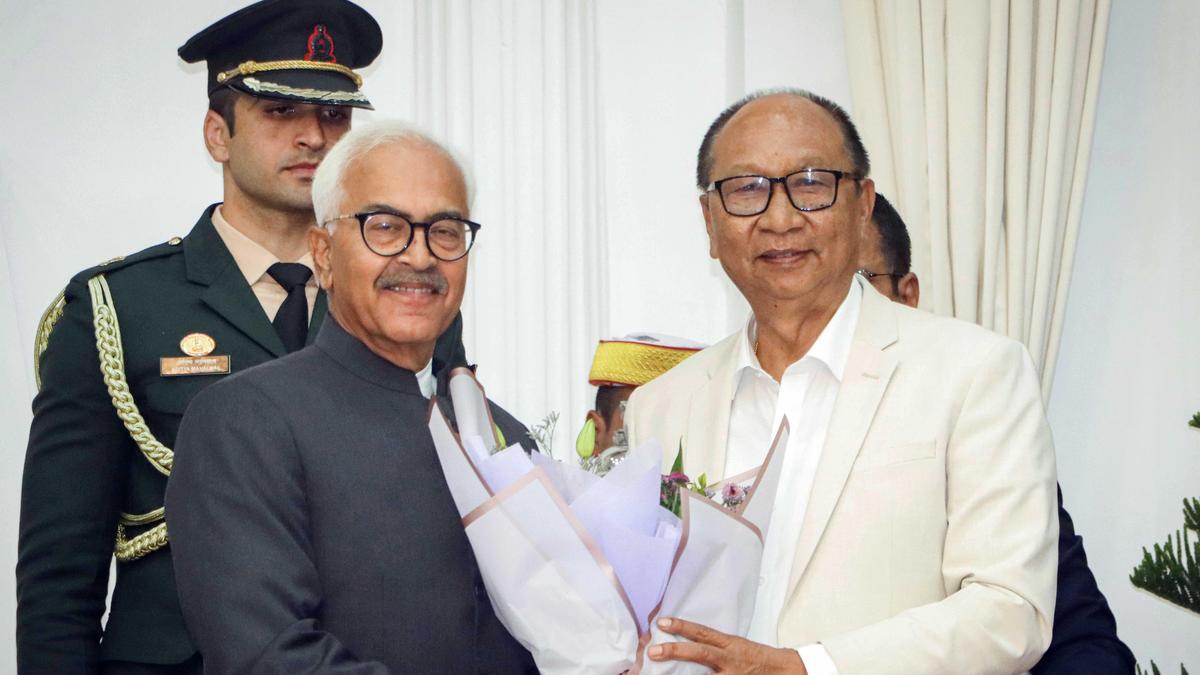
BJP leader Yumnam Khemchand Singh was sworn in as the 13th Chief Minister of Manipur.
Nemcha Kipgen (Kuki-Zo community) and Losii Dikho (Naga People’s Front ally) were appointed as Deputy Chief Ministers.
Political Compulsions Behind the Move
Revocation avoided extending President’s Rule beyond one year, which would have required a Constitution Amendment Bill in Parliament.
It also allowed the BJP to project democratic governance and attempt to regain public support in the Assembly’s final year.
Background of Discontent and Leadership Change
- Biren Singh’s second termtriggered widespread public angerin both the hills and the valley.
This dissatisfaction was reflected in the victory of Opposition candidates in the general election.
As sporadic violence spread, internal BJP critics — including Khemchand Singh — pushed for a leadership change.
Biren Singh’s presence during Khemchand Singh’s nomination indicated party consensus.
Khemchand Singh had earlier signalled reconciliation efforts by visiting a Kuki-Zo relief camp in Naga-dominated Ukhrul district.
Limits of President’s Rule
President’s Rule aimed to curb armed radical groups and enable the return of displaced persons.
Security forces recovered many looted weapons and reduced militant activity.
However, only 9,000 of nearly 60,000 displaced people have returned, highlighting a deep trust deficit.
Continuing Violence and Trust Deficit
Incidents like the execution of a Meitei man in Churachandpur while visiting his Kuki-Zo wife underline the ongoing influence of radical groups.
Such acts show that the human cost of ethnic conflict remains unresolved.
Challenges Before the New Government
While the BJP has used political survival to maintain internal unity, inter-community reconciliation is far more difficult.
Continued demands by Kuki-Zo groups for a “separate administration” risk widening divisions.
Mere symbolic representation in leadership will not ensure peace.
Way Forward for Stability
Lasting stability requires inclusive dialogue involving all communities.
The government must engage political parties, civil society, and community leaders to rebuild trust and social cohesion.
Conclusion
The end of President’s Rule and the installation of a new government offer Manipur a chance to restore democratic legitimacy. However, political consensus alone cannot heal deep ethnic wounds. Sustainable peace will depend on firm action against radical groups and an inclusive dialogue that rebuilds trust among all communities beyond symbolic power-sharing.
Article 2: Sixteenth Finance Commission
Why in news: The Sixteenth Finance Commission (2024–29) has been constituted by the President of India to recommend the sharing of central taxes, grants-in-aid, and measures to improve financial stability of States in the context of emerging challenges such as climate change, population dynamics, and fiscal sustainability.
Key Details
Constitutional body under Article 280
Constituted by the President of India
Appointed every five years
Recommends Centre–State tax devolution
Decides horizontal distribution among States
Suggests grants-in-aid under Article 275
Strengthens fiscal federalism
Recommendations are advisory in nature
Constitutional Basis
Established under Article 280 of the Indian Constitution
Ensures equitable distribution of financial resources between Centre and States
Key pillar of fiscal federalism
Composition and Appointment
Constituted by the President of India
Appointed every five years or earlier if required
Consists of
Chairperson
Four members with expertise in public finance, economics, law, and administration
Tenure and Nature
Tenure normally five years
Recommendations are advisory, but have high constitutional authority
Generally accepted by the Union Government
Core Functions
Recommend vertical devolution of taxes between Centre and States
Decide horizontal distribution of resources among States
Suggest grants-in-aid under Article 275
Advise on measures to augment State Consolidated Funds to support local bodies
Vertical Devolution
Determines share of States in net proceeds of central taxes
Aims to strengthen financial autonomy of States
Enhances cooperative federalism
Horizontal Devolution Criteria
Income distance – to address regional inequalities
Population – reflects expenditure needs
Area – accounts for administrative costs
Forest and ecology – compensates States for conservation
Demographic performance – rewards population control
Fiscal discipline – incentivises responsible finances
Grants-in-Aid
Revenue deficit grants for fiscally stressed States
Local body grants for Panchayats and Municipalities
Sector-specific grants for
Health
Education
Disaster management
Infrastructure
Role in Local Governance
Recommends grants to strengthen third tier of government
Supports devolution to local bodies
Encourages transparency, accountability, and service delivery
Recent Trends
Shift towards performance-based incentives
Greater emphasis on
Climate change and environment
Demographic transition
Fiscal sustainability
Consideration of defence and internal security needs
Significance
Promotes balanced regional development
Strengthens macroeconomic stability
Acts as a stabilising force in Centre-State relations
Way Forward
Strengthening Fiscal Federalism
Ensure predictability and stability in tax devolution
Reduce ad-hoc transfers and enhance rule-based fiscal sharing
Improving Devolution Criteria
Regularly update criteria to reflect changing socio-economic realities
Balance equity with efficiency in horizontal distribution
Enhancing State Capacity
Support States in improving tax effort and public financial management
Encourage adoption of outcome-based budgeting
Focus on Local Governments
Increase direct and timely transfers to Panchayats and Municipalities
Link grants to service delivery outcomes and accountability mechanisms
Addressing Emerging Challenges
Mainstream climate change, urbanisation, and aging population concerns
Design targeted grants for climate resilience and disaster preparedness
Strengthening Cooperative Federalism
Promote wider consultation with States before finalising recommendations
Enhance transparency in decision-making and implementation
Conclusion
The Finance Commission remains a cornerstone of India’s fiscal architecture, balancing national priorities with State autonomy. Adapting its framework to emerging socio-economic challenges is crucial for sustaining inclusive growth and federal harmony.
EXPECTED QUESTIONS FOR PRELIMS:
Which of the following is/are functions of the Finance Commission?
Distribution of taxes between Centre and States
Distribution of taxes among States
Advising on borrowing limits of States
Select the correct answer:
(a) 1 and 2 only
(b) 2 and 3 only
(c) 1 only
(d) 1, 2 and 3
Answer: a
Article 3: The U.S. trade deal, gains from economic diplomacy
Why in news: The India–U.S. trade deal is in focus due to a sharp U.S. tariff cut to 18%, boosting Indian exports and competitiveness.
Key Details
U.S. tariffs on Indian goods reduced from 50% to 18%
Enhances market access to India’s largest export destination
Benefits employment-intensive sectors like apparel, gems and jewellery
Improves India’s position against China, ASEAN and other competitors
Supports progress under the India–U.S. Bilateral Trade Agreement (BTA)
India’s trade strategy: scale, speed and structure
India’s trade playbook is delivering results strongly, steadily and at scale.
A new trade architecture, likened to a high-speed expressway, is emerging—anchored in strategic trade agreements that ensure faster and more predictable trade flows.
After concluding major agreements with the EU, the U.K. and other partners, India has now secured a consequential trade deal with the United States, marking a major step in its global trade push.
The India–U.S. deal: process, tariffs and immediate impact
The agreement followed a long, complex and demanding negotiation process, reflecting the strength, steadiness and foresight of Indian negotiators.
After nearly a year of sustained dialogue, technical negotiations and quiet diplomacy, both sides agreed on a reduced U.S. tariff of 18% on Indian goods.
This sharp reduction from earlier 50% tariff levels gives a major boost to Indian exports, improving market access, policy certainty and opening avenues for new strategic partnerships.
The tariff relief also provides a constructive platform to advance talks under the ongoing India–U.S. Bilateral Trade Agreement (BTA) by easing immediate trade frictions.
Expanding partnerships and sectoral gains
The India–U.S. deal fits into India’s growing global network of trade partnerships.
Agreements with EFTA, the U.K. and the EU provide preferential access to the entire European market.
Deals with Australia and New Zealand strengthen India’s role in the Pacific, while agreements with Oman and the UAE enhance access to West Asia.
The U.S., the world’s largest import market, is India’s biggest export destination, accounting for nearly one-fifth of total exports.
Indian exports to the U.S. span apparel, gems and jewellery, agricultural products, footwear, leather and diverse manufactured goods, supporting employment and manufacturing value chains at home.
The tariff cut restores price competitiveness, especially for employment-intensive sectors such as apparel, where India now faces a lower tariff than competitors like Vietnam and Bangladesh.
Similar gains accrue to gems and jewellery, marine products, processed foods, footwear and leather, where even modest tariff reductions significantly improve landed costs and encourage capacity expansion.
Broader economic and strategic implications
Lower U.S. tariffs immediately strengthen India’s position vis-à-vis competitors facing higher duties, including China, Bangladesh, Sri Lanka, Brazil, South Africa, Pakistan and ASEAN countries.
This improved competitiveness supports India’s long-term ambition of becoming a global manufacturing hub and a key node in diversified global supply chains.
Beyond short-term relief, the deal promotes long-term growth through joint ventures, technology partnerships and investment in high-value sectors, fostering innovation, jobs and skill development.
For India, it consolidates global economic leadership and capacity for high-value international partnerships; for the U.S., it underscores the benefits of partnering with India to expand markets, innovate and reinforce supply chains.
Progress on tariffs enables deeper cooperation in regulatory coordination, digital trade, clean energy and innovation-led sectors, creating a mutually reinforcing cycle of growth.
Strategically, closer economic ties complement cooperation in forums like the Quad, where supply-chain resilience and trusted partnerships are central.
More than a tariff adjustment, the deal marks a shift from tariffs to trust—a strategic reset that strengthens ties in technology, defence, energy and high-value manufacturing.
With policy momentum in place, the next phase depends on industry action—leveraging improved access through investment, scale and enhanced competitiveness to realise the deal’s full potential.
Way Forward
Effective implementation of the trade deal and timely follow-up under the Bilateral Trade Agreement (BTA)
Industry-led investment in capacity expansion, technology upgradation and productivity enhancement
Deeper integration into global value chains and supply-chain diversification
Strengthening regulatory cooperation, digital trade frameworks and clean energy collaboration
Leveraging the partnership to boost innovation, employment and long-term economic growth
Conclusion
India’s trade strategy is yielding tangible results, with the India–U.S. deal marking a major economic and strategic milestone. Lower tariffs strengthen export competitiveness, deepen global integration and reinforce trust between two democracies. Beyond immediate gains, the agreement positions India as a reliable trade partner and advances its ambition of becoming a global manufacturing and supply-chain hub.
Descriptive question:
Examine how the India–U.S. trade deal reshapes India’s export competitiveness and long-term manufacturing ambitions. (10 marks, 150 words)
