

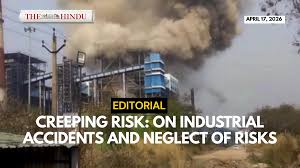
17 April 2026 The Hindu Editorial
What to Read in The Hindu Editorial ( Topic and Syllabus wise)
Article 1: Creeping risk
Why in news: Recent boiler explosion in Sakti, Chhattisgarh, killing 20 people, has highlighted recurring industrial safety failures, regulatory gaps, unsafe restart practices, and poor labour protections amid India’s expanding industrial capacity.
Key Details
Boiler explosions arise from gradual risks like pressure imbalance and poor maintenance
Restart phases and partial-capacity operations are highly vulnerable periods
Weak inspection regime relies on annual certification and self-compliance
Contract labour faces unsafe conditions with limited awareness and accountability
Regulatory gaps under OSHW Code dilute employer liability in safety lapses
Engineering Causes Behind Boiler Explosions
Boiler explosions rarely occur suddenly; risks build gradually over time
Key causes include overpressure, scaling, poor water level management, and restart stress
Failures often emerge during unstable operating phases, not normal conditions
Thermal and pressure imbalances during restart phases increase vulnerability
Indicates systemic neglect rather than isolated technical failure
Lessons from Recent Industrial Disasters
The Sakti (Chhattisgarh) explosion shares patterns with earlier incidents
The Visakhapatnam Gas Leak 2020 involved inactive or poorly calibrated safety systems post-lockdown
The Neyveli Thermal Plant Explosion 2020 was triggered during a plant restart process
Sakti plant was recently acquired, commissioned, and not at full capacity
Highlights risks associated with transitional and restart operations
Regulatory and Inspection Gaps
Boiler certification remains valid for up to one year, despite daily condition changes
Lack of enhanced monitoring during high-risk phases like restart or low-capacity operation
Existing system penalizes downtime instead of encouraging preventive shutdowns
Greater focus on fabrication standards rather than real-time monitoring and audits
Shift toward self-certification and scheduled audits reduces surprise inspections
Labour Vulnerability and Safety Issues
Contract and migrant workers face the highest risks
Subcontracting leads to diffused accountability after accidents
Safety manuals and signage often not available in workers’ native languages
Workers frequently lack awareness of hazardous materials they handle
Weak legal accountability under the Occupational Safety, Health and Working Conditions Code 2020 for principal employers
Structural Challenges in Industrial Expansion
Rapid industrial growth is straining ageing infrastructure
Plants increasingly operate near maximum capacity, raising risk levels
Safety lapses are now receiving greater media and political scrutiny
Many “accidents” may reflect chronic unsafe working conditions
Without reform, unsafe practices remain normalized as a cost of doing business
Conclusion
Industrial disasters such as the Sakti explosion expose deep-rooted structural flaws in India’s safety ecosystem, including weak enforcement, poor labour safeguards, and misplaced regulatory priorities. Without strengthening real-time monitoring, ensuring strict accountability, and prioritising worker safety over operational efficiency, such incidents will persist. A shift towards a proactive safety culture is essential to prevent tragedies being treated as routine costs.
Descriptive question:
- Industrial accidents in India are less about technical failure and more about systemic neglect. Critically examine. (10 marks,150 words)
Article 2: Unlawful Activities (Prevention) Act
Why in news: Recent debates on the Unlawful Activities (Prevention) Act have intensified after court observations on bail provisions, prolonged detention, and concerns over misuse against activists, highlighting tensions between security and civil liberties.
Key Details
Primary anti-terror law aimed at protecting sovereignty and integrity of India
Allows designation of individuals and organisations as terrorists
Provides for extended detention and stringent bail conditions
Empowers agencies like NIA with wider investigative authority
Criticised for low conviction rates and potential misuse
Raises concerns over civil liberties and due process
Background and Objective
Enacted in 1967 to prevent unlawful activities threatening India’s sovereignty and integrity
Strengthened over time to address terrorism and national security challenges
Empowers the State to act against secessionist and anti-national activities
Expanded after major terror incidents to include counter-terror provisions
Serves as India’s primary anti-terror legislation
Key Provisions
Allows designation of individuals and organisations as terrorists
Provides for extended detention and investigation periods
Permits attachment and seizure of property linked to terrorism
Establishes special courts for speedy trials
Imposes strict bail conditions, making release difficult
Amendments and Evolution
Major amendments in 2004, 2008, 2012, and 2019
2019 amendment enabled individuals (not just organisations) to be labelled terrorists
Enhanced powers for National Investigation Agency (NIA)
Expanded scope to include terror financing and cyber activities
Reflects shift toward a more stringent security framework
Concerns and Criticisms
Criticised for potential misuse against dissent and activists
Stringent bail provisions raise issues of prolonged incarceration
Low conviction rates highlight concerns of procedural fairness
Risk of overreach and violation of civil liberties
Often seen as prioritising state power over individual rights
Judicial and Legal Safeguards
Courts emphasise strict scrutiny in application of provisions
Supreme Court has stressed balance between security and liberty
Requirement of sanction before prosecution in certain cases
Judicial review acts as a check on arbitrary use
Ongoing debates on reforms and safeguards
Significance and Way Forward
Remains crucial for counter-terrorism and national security
Needs clear safeguards to prevent misuse
Emphasis on accountability and transparency in enforcement
Strengthening judicial oversight and timely trials is essential
Balancing security with democratic freedoms is the key challenge
Conclusion
The UAPA remains a critical legal tool for safeguarding national security, but its stringent provisions risk undermining civil liberties if misapplied. Ensuring a balance between effective counter-terrorism and constitutional freedoms requires stronger judicial oversight, transparent enforcement, and timely trials. Reforming procedural safeguards while preserving its core objective is essential to maintain both security and democratic integrity in India.:
Article 3: India’s rural models are shaping development diplomacy
Why in news: India’s National Rural Livelihood Mission (NRLM) gains global attention as its SHG-based model expands across Africa, highlighting success in women empowerment, financial inclusion, and South-South development cooperation.
Key Details
NRLM has mobilised over 100 million rural households into self-help groups (SHGs)
Enabled financial inclusion and credit access for over 50 million women
Promotes women-led livelihoods, skills, and community institutions
Model is being adopted by African countries for inclusive development
Strengthens India’s development diplomacy through knowledge-sharing
Objectives of NRLM
Launched in 2011 to reduce multidimensional rural poverty
Focus on self-employment, financial inclusion, and skill development
Aims to create sustainable livelihoods for rural households
Targets women-led economic empowerment through SHGs
Promotes long-term capacity building and income generation
Scale and Achievements
Covers over 100 million households across 742 districts
Mobilised 9 million+ Self-Help Groups (SHGs)
Over 20 million women earning ₹1 lakh+ annually
Enabled ₹12 lakh crore bank linkage and ₹51,368 crore support
Strengthened by ₹19,200 crore allocation in Union Budget 2026–27
Institutional Framework
Built multi-tier community institutions (village to block level)
Developed community-based cadres for last-mile delivery
Integrated women into formal financial systems
Encourages peer learning and collective decision-making
Ensures financial discipline and accountability mechanisms
Global Expansion and Influence
Model being adopted across Global South, especially Africa
Countries like Ethiopia, Kenya, Tanzania, Rwanda studying NRLM
Promotes South-South cooperation and peer learning
Seen as a replicable and scalable development model
Reflects shift from Western models to local innovations
Reasons for Global Appeal
Emphasis on women’s collective empowerment
Low-cost, community-driven approach suitable for developing nations
Fits informal economies and microenterprise needs
Focus on institution-building rather than short-term schemes
Strengthens local governance and accountability
Role in India’s Development Diplomacy
Marks shift toward exporting institutional development models
Builds long-term partnerships and knowledge exchange
Opens avenues in digital governance, finance, and agriculture
Suggests need for a Rural Livelihood Knowledge Exchange Platform
Positions India as a leader in global development practices
Conclusion
The NRLM represents a transformative model of inclusive rural development by combining social mobilisation, financial access, and institutional capacity-building. Its growing global adoption reflects the strength of locally rooted, scalable solutions from the Global South. By exporting such models, India is redefining development cooperation beyond aid, fostering partnerships based on shared experiences, sustainability, and empowerment-driven growth.
Descriptive question:
- “The National Rural Livelihood Mission (NRLM) exemplifies how domestic development models can shape global cooperation.” Discuss. (15 marks, 250 words)
