

22 October 2025 Indian Express Editorial
What to Read in Indian Express Editorial( Topic and Syllabus wise)
Editorial 1 : Post-Diwali farm challenge
Context: Until recently, controlling food inflation was a central policy focus for the Indian government. However, with the easing of supply pressures and the emergence of a glut in several key crops, the challenge after Diwali 2025 has shifted. Policymakers now face a complex trade-off of balancing consumer welfare with the urgent need to protect farmer incomes as crop prices fall below incomes as crop prices fall below Minimum Support Prices (MSP).
Decline in Food Inflation:
- Retail food inflation has been in negative territory for the last four consecutive months ending September 2025.
- This marks a sharp reversal from the 18-month period between July 2022 and December 2023, when inflation in food items averaged around 8.5%.
- Favorable weather conditions, successive good monsoons, and improved harvests have collectively boosted supply, leading to stabilization or decline in food prices.
Over supply of Cereals and overflowing PDS stocks:
- The cereal market exemplifies the current oversupply problem.
- Wheat stocks in government warehouses on October 1, 2023, stood at 26.7 million tonnes, well above the buffer norm of 20.5 million tonnes and even higher than the previous year’s 24.6 million tonnes.
- Similarly, rice stocks stood at 41.6 million tonnes, nearly double the required buffer of 13.5 million tonnes.
- This situation reflects an abundant supply of cereals due to back-to-back good harvests.
- As a result, market prices have dropped significantly, with open-market wheat and rice prices ruling much below their MSPs.
- Government procurement at MSPshas thus become the primary channel sustaining demand, but this also raises fiscal concerns, as maintaining such large stocks imposes storage and subsidy burdens.
The anomaly of Oilseeds production and crucial case of Soybean:
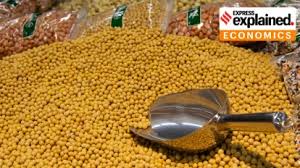
- Soybean illustrates another dimension of the glut.
- Despite not-so-great production figures, prices have fallen well below MSP levels due to global oversupply and weak demand.
- According to the Solvent Extractors’ Association of India (SEA), India’s soybean crop for 2024–25 was around 120 lakh tonnes, but opening stocks and weak exports have led to overall excess availability.
- At present, soybean prices in Madhya Pradesh, India’s key producing state, are ruling around ₹4,100–₹4,200 per quintal, significantly below the MSP of ₹5,328 per quintal.
- Such a sharp price fall threatens farmer profitability, especially since input costs like fertilizers and diesel remain elevated.
Changing Policy Focus:
- Till last year, the government’s main policy priority was curbing food inflation to protect consumers.
- However, with food prices stabilizing and some commodities turning deflationary, the focus must now pivot towards supporting farmers facing distress sales.
- The excess supply and declining prices indicate a need for recalibrating agricultural policy.
- One immediate measure could involve expanding procurement operations beyond cereals to oilseeds and pulses.
- Additionally, export promotion and diversification of uses(e.g., for biofuel or feed industries) can help absorb surplus production.
Fiscal and Structural Implications:
- While expanded procurement may offer short-term relief, it also risks increasing fiscal pressure due to higher food subsidy requirements.
- The current stockpile of cereals already exceeds buffer norms by wide margins, and holding these stocks incurs substantial costs.
- Moreover, such policies can perpetuate production distortions encouraging farmers to continue sowing water-intensive or surplus crops.
Way forward:
After a period dominated by inflation control, attention must now shift to protecting farm incomes amid a glut situation. The task ahead involves balancing consumer and farmer interests while maintaining fiscal prudence. Ensuring remunerative prices for farmers through smarter procurement, export incentives, and crop diversification will be essential to sustain agricultural growth and rural livelihoods in 2025–26.
Editorial 2 : On Air, Connect the Dots
Context: India’s winter season is traditionally marked by deteriorating air quality, particularly in North India, as a combination of meteorological and anthropogenic factors converges to create smog and pollution episodes. This autumn witnessed better air quality compared to previous years due to many factors. However, this must be seen in a larger climatic and environmental context that signals potential worsening in the coming months.
Factors responsible for this short-term improvement in air quality:
- This short-term improvement may be attributed to warmer-than-usual weather and a timely withdrawal of the monsoon, both of which contributed to better atmospheric dispersion.
- In recent years, delayed monsoon withdrawal has become more common, often leading to stagnant air, lower wind speeds, and higher humidity conditionsthat trap pollutants near the surface.
- This year, however, the monsoon withdrew relatively on time, ensuring sustained air movement and dilution of pollutants.
- This created a marginally favorable situation compared to the severe smog episodes seen around Diwali in earlier years.
El Niño, La Niña, and Transition Effects:
- According to recent studies by the National Institute of Advanced Studies (NIAS) and the System of Air Quality and Weather Forecasting and Research (SAFAR), the past few years have been influenced by El Niño conditions, which tend to elevate surface temperatures and alter rainfall patterns.
- Now, as the climatic phase transitions towards a weak La Niña, a new set of challenges emerges.
- A weak La Niña, though typically associated with cooler global temperatures, can also prolong winters in India and lead to extended periods of stagnant air.
- This stagnation hampers vertical and horizontal mixing in the lower atmosphere, allowing pollutants from vehicles, biomass burning, and industrial sources to accumulate.
- Therefore, while the Diwali period may have seen relatively cleaner air, the coming winter could witness a renewed surge in pollution levels.
Stubble Burning and Delayed Harvest:
One of the critical anthropogenic contributors to North India’s air pollution crisis remains stubble burning in Punjab and Haryana.
- The erratic rainfall and climate shifts have delayed the paddy harvest this year.
- As a result, the burning of crop residue is expected to peak later than usual in late October and November coinciding with falling temperatures and lower wind speeds.
- This overlap between climatic stagnation and agricultural emissions poses a significant threat to air quality in the Indo-Gangetic plains and the Delhi-NCR region.
- Despite ongoing policy efforts and incentives to curb stubble burning, enforcement challenges persist, and sustainable alternatives for crop residue management remain limited.
Holistic Air Quality Management Strategy:
- India’s air pollution problem is not limited to local emissionsbut is part of a broader climate-air interaction system.
- Warmer global temperatures, shifting rainfall patterns, and urban heat island effectsexacerbate pollution retention.
- Effective mitigation, therefore, demands that climate change adaptation and air quality policies be interlinked.
- Strengthening early warning systems, improving crop residue utilization (for bioenergy or compost), promoting electric mobility, and expanding green buffers are essential components of a sustainable response.
Long term challenge of Air pollution:
- While Diwali 2025 may have witnessed better air conditions than in previous years, this is no cause for complacency.
- The weak La Niña phase, delayed crop residue burning, and cooling temperatures could create an environment conducive to prolonged smog episodes in November and December.
- Policymakers, therefore, must act proactively, guided by integrated data and scientific forecasting.
Way forward:
India’s air quality challenges cannot be addressed through isolated or seasonal interventions. Instead, they require a connected, climate-aware strategy that accounts for meteorological patterns, agricultural practices, and urban emissions together. India may hope to achieve lasting improvements in air quality and public health by taking into account climate variability, human behaviour, and environmental policy.
