

26 February 2026 Indian Express Editorial
What to Read in Indian Express Editorial ( Topic and Syllabus wise)
Article 1: In US Tariff Judgment, How Judiciary Drew the Red Line
Why in News: A US court in Learning Resources Inc. v. Donald J. Trump (2026) struck down tariff actions, highlighting judicial limits on executive economic powers.
Key Details
US courts held certain tariffs imposed by former President Donald Trump unconstitutional.
The dispute centred on whether emergency powers under the International Emergency Economic Powers Act (IEEPA) allow tariff imposition.
The judiciary reaffirmed that taxation powers primarily rest with the legislature (Congress).
The ruling underscores the doctrine of separation of powers in constitutional democracies.
Background of the Case
Trigger for litigation: Small US businesses importing goods from China challenged the tariff hikes, arguing they exceeded presidential authority and harmed trade.
Nature of the ruling (2026): In Learning Resources Inc. v. Donald J. Trump, the court (6:3 majority) held that the tariffs imposed under emergency powers were unconstitutional.
Tariff escalation context: Tariffs on Chinese goods reportedly rose in phases from 10% to as high as 125%, affecting global trade flows including India.
Broader significance: The judgment is being seen as a landmark in defining limits of executive power in trade policy.
Legal Framework: IEEPA and Emergency Powers
Purpose of IEEPA: The International Emergency Economic Powers Act allows the US President to regulate economic transactions during a declared national emergency.
Scope of authority: Sections 1701–1702 permit the President to investigate, regulate, or prohibit foreign economic transactions, but the extent of tariff powers was disputed.
Emergency declaration by executive: The tariffs were justified on grounds of drug inflows and persistent trade deficits threatening US supply chains.
Core legal question: Whether the power to “regulate imports” implicitly includes the power to impose tariffs (taxes).
Majority Judgment: Red Line for Executive Power
Taxation power lies with legislature: The court relied on Article I, Section 8 of the US Constitution, which gives Congress the exclusive power to levy taxes and duties.
Narrow interpretation of ‘regulate’: The majority held that regulation does not automatically include taxation, especially when the statute does not explicitly say so.
Application of Major Questions Doctrine: The court invoked this doctrine, requiring clear congressional authorisation for executive actions with vast economic consequences.
Rule of law emphasis: Judges rejected government arguments about economic fallout, stressing that constitutional limits cannot be bypassed for policy convenience.
Dissenting Opinion: Broad Executive Authority
Expansive reading of regulation: The minority judges argued that regulating imports historically includes tools like tariffs, quotas, and embargoes.
Historical precedents cited: Reference was made to tariff actions by earlier presidents such as Richard Nixon and Gerald Ford.
Emergency flexibility argument: The dissent emphasised that during national emergencies, executive power should be interpreted pragmatically and broadly.
Warning of economic disruption: The minority cautioned that invalidating tariffs could lead to massive refund liabilities and policy uncertainty.
Separation of Powers: Core Constitutional Principle
Checks and balances in action: The judgment reinforces that in a republic, legislature makes tax laws, executive implements, judiciary reviews.
Judicial review as guardian: Courts act as the final arbiter when executive actions potentially cross constitutional boundaries.
Comparative relevance for India: India also follows separation of powers, though not in a strict sense, with judicial review recognised under the basic structure doctrine.
Democratic accountability: The ruling highlights that even strong executives must operate within statutory and constitutional limits.
Global and India-Specific Implications
Trade policy uncertainty: The decision may affect future US tariff strategies, creating uncertainty for major exporters including India.
Alternative legal routes: The dissent noted other US laws (Trade Expansion Act 1962, Trade Act 1974) that could still permit tariffs.
Impact on global supply chains: Frequent tariff changes can disrupt investment planning, commodity flows, and WTO dynamics.
Lesson for policymakers: Economic nationalism must remain consistent with constitutional and legal frameworks.
Conclusion
The US tariff judgment is a powerful reaffirmation of the rule of law and separation of powers in modern democracies. It demonstrates that even in matters of national economic policy, executive authority is not unlimited. For India and other trading partners, the ruling signals continued uncertainty in global trade but also underscores the importance of institutional checks and constitutional discipline in governance.
EXPECTED QUESTIONS FOR UPSC CSE
Prelims MCQ
- The “Major Questions Doctrine,” recently seen in news, is related to:
(a) Federalism disputes
(b) Executive power requiring clear legislative authorisation
(c) Judicial appointments
(d) Monetary policy
Answer: (b)
Descriptive Question
- Discuss how the recent US tariff judgment reflects the doctrine of separation of powers. What lessons does it hold for constitutional democracies like India? (150 Words, 10 Marks)
Article 2: India’s Defence Surge
Why in News: The Union Budget 2026–27 has sharply increased India’s defence allocation, reigniting debate on whether the move reflects militarisation or strategic necessity.
Key Details
India allocated a record ₹7.85 lakh crore for defence in Budget 2026–27, a 15.19% increase over the previous year.
Capital outlay rose by 21.8% to ₹2.19 lakh crore to accelerate military modernisation.
Around 75% of modernisation funds are earmarked for domestic procurement under Atmanirbhar Bharat.
The surge is aimed at strengthening credible deterrence amid a complex security environment.
India’s Defence Budget Surge
Record Allocation: The defence budget of ₹7.85 lakh crore (≈$86.7 billion) marks India’s highest-ever spending, reflecting prioritisation of national security in fiscal planning.
Rise in Capital Expenditure: Capital outlay increased to ₹2.19 lakh crore, focusing on acquisition of fighter aircraft, submarines, drones, and advanced surveillance systems.
Operational Preparedness: Revenue expenditure of ₹3.65 lakh crore supports salaries, logistics, and maintenance, ensuring forces remain combat-ready after recent operational experiences.
Long-term Modernisation Push: The spending pattern shows a shift from manpower-heavy defence to technology-driven capability building, consistent with modern warfare trends.
Strategic Logic of Deterrence
Deterrence vs Militarism: Defence strengthening aims to prevent conflict by raising the cost of aggression, not to pursue expansionist ambitions.
Credible Capability Requirement: Effective deterrence depends on material capability—modern platforms, surveillance, and rapid response—not merely diplomatic signalling.
Closing Preparedness Gaps: Parliamentary committees and military leadership have repeatedly flagged shortages in fighter squadrons, air defence, and naval assets.
Insurance Against Coercion: Underinvestment historically invites pressure from adversaries; therefore, enhanced spending acts as strategic insurance.
India’s Evolving Security Environment
China Challenge: China has undertaken two decades of rapid military modernisation and hardened positions along the Line of Actual Control, highlighted by the 2020 Galwan crisis.
Pakistan’s Risk Posture: Pakistan’s strategy combines nuclear deterrence with conventional provocations, creating persistent instability along India’s western front.
Two-Front Contingency: Growing China–Pakistan strategic coordination raises concerns about simultaneous pressure on India’s northern and western borders.
Expanding Maritime Theatre: India’s responsibilities in the Indian Ocean Region have increased amid rising great-power competition and sea-lane security concerns.
Atmanirbhar Bharat in Defence
Domestic Procurement Push: Allocating nearly 75% of modernisation funds for indigenous sources aims to reduce import dependence and build strategic autonomy.
Boost to Defence Industrial Base: Indigenous production of drones, missiles, aircraft components, and naval platforms supports job creation and technological capability.
Reduced External Vulnerability: Dependence on foreign suppliers can create supply shocks during crises; indigenisation enhances reliability of defence supply chains.
Export Potential: India’s defence exports crossed ₹21,000 crore in recent years, indicating growing global competitiveness of domestic defence manufacturing.
Strategic Autonomy and Global Uncertainty
Unpredictable Global Order: Shifts in major power policies and transactional geopolitics make over-reliance on external security guarantees risky.
Autonomy through Capability: True strategic autonomy requires the ability to defend borders, protect sea lanes, and sustain conflict independently.
Regional Stability Role: A militarily credible India contributes to balance of power in Asia and supports a stable Indo-Pacific order.
Not an Arms Race: India’s spending remains defensive and gap-filling, not aimed at parity with larger military powers.
Concerns and Challenges
Fiscal Trade-offs: Higher defence spending must be balanced with social sector needs such as health, education, and infrastructure.
Efficiency of Procurement: Delays in acquisition and cost overruns in defence projects remain persistent structural issues.
Need for Jointness and Reform: Budget increases must be complemented by theatre commands, integration, and doctrinal modernisation.
Technology Absorption: Simply buying platforms is insufficient; emphasis must be on network-centric warfare, AI, cyber, and space capabilities.
Conclusion
India’s recent defence surge represents a course correction toward credible deterrence, not militaristic expansion. In an era of complex threats and uncertain geopolitics, strengthening military capability is essential for safeguarding sovereignty and sustaining strategic autonomy. Going forward, India must pair higher spending with defence reforms, indigenous innovation, and joint force integration to ensure that capability translates into effective security outcomes. A secure India ultimately contributes to a more stable Asia.
EXPECTED QUESTIONS FOR UPSC CSE
Prelims MCQ
- Which of the following best describes the concept of “credible deterrence”?
(a) Increasing troop numbers alone
(b) Preventing conflict by raising the cost of aggression
(c) Avoiding defence expenditure
(d) Relying solely on nuclear weapons
Answer: (b)
Descriptive Question
- “India’s rising defence expenditure reflects strategic maturity rather than militarism.” Examine in the context of India’s security environment. (150 Words, 10 Marks)
Article 3: Trump Says US Economy is Booming
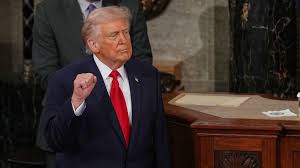
Why in News: The US President, during his recent State of the Union (SOTU) address (February 2026), claimed that the American economy is stronger than ever, although economic data presents a mixed picture.
Key Details
The President asserted that inflation is falling, incomes are rising, and economic growth is robust.
Data shows GDP growth has moderated, inflation remains sticky, and job creation is uneven.
Tariffs imposed by the US have been ruled partly illegal by the US Supreme Court.
The US trade deficit has widened despite tariff measures.
State of the Union (SOTU)
Constitutional Mandate: The State of the Union address is mandated under Article II of the US Constitution, requiring the President to periodically inform Congress about national conditions.
Political Significance: It is both a policy statement and political messaging tool, especially relevant before Congressional midterm elections.
Approval Ratings and Electoral Stakes: With declining approval ratings and potential Congressional losses, the speech aimed to reassure voters about economic performance.
Judicial Constraints: The US Supreme Court’s recent ruling declaring several tariffs illegal has constrained executive authority over trade policy.
Economic Growth: GDP Performance
Post-Pandemic Recovery: The US experienced a strong “V-shaped recovery” after COVID-19, regaining pre-pandemic GDP levels faster than most major economies.
Moderation in Growth (2025): Real GDP growth slowed compared to previous years, contradicting claims of record expansion.
Sectoral Contribution: Growth has been largely driven by services, technology, and consumption, rather than manufacturing revival.
Global Comparison: The US remains the world’s largest economy, contributing nearly 24% of global GDP, but faces competition from China and the EU.
Inflation and Affordability
Peak Inflation (2022): Inflation reached 9.1% in June 2022, the highest in four decades, driven by supply chain disruptions and the Russia-Ukraine conflict.
Moderation but “Sticky” Inflation: By January 2025, inflation fell below 3%, but reciprocal tariffs announced in April caused renewed upward pressure.
Tariff Impact: Studies show over 90% of tariff costs were borne by American consumers and companies, increasing domestic prices.
Monetary Policy Response: The US Federal Reserve maintained high interest rates to control inflation, impacting housing loans, car loans, and consumer borrowing.
Employment Trends
Overall Job Numbers: Total non-farm employment reached record levels (over 158 million jobs in early 2026).
Low Hire–Low Fire Phenomenon: Both hiring and layoffs remain subdued, reflecting labour market caution amid economic uncertainty.
Sectoral Imbalance: Job growth is concentrated in private health and education (+773,000 jobs in 2025), while manufacturing employment declined.
Structural Challenges: Automation, Artificial Intelligence, and immigration policies are reshaping the labour market structure.
Trade Deficit and Tariff Policy
Rising Trade Deficit: The US trade deficit widened from approximately $1.05 trillion (2023) to over $1.24 trillion (2025).
Limited Revenue from Tariffs: Tariffs generated less than $200 billion in FY25, compared to over $2.7 trillion from income tax.
Economic Theory Perspective: Protectionist tariffs may shield domestic industries temporarily but increase consumer prices and reduce competitiveness.
Global Implications: Tariff escalation affects global supply chains and may trigger retaliatory trade measures, impacting emerging economies including India.
Welfare and Tax Measures
Tax Reforms: Measures such as “no tax on tips” and tax-free child investment accounts aim to improve household disposable income.
Healthcare Provisions: The administration proposed reducing prescription drug prices to improve affordability.
Mortgage Rate Reduction: Interest rate moderation has reduced annual mortgage burdens by nearly $5,000 for typical borrowers.
Fiscal Sustainability Concern: Expansionary tax cuts combined with tariffs raise concerns about rising fiscal deficits.
Global and Indian Relevance
Impact on Global Economy: As the largest economy, US slowdown or trade shifts directly influence global capital flows and exchange rates.
India–US Trade Relations: Tariff policies affect sectors like pharmaceuticals, IT services, textiles, and agriculture exports from India.
Geopolitical Linkages: Economic strength influences US foreign policy, NATO commitments, and Indo-Pacific strategy.
Lessons for India: Balancing protectionism and free trade, managing inflation, and ensuring employment-intensive growth are key policy lessons.
Conclusion
The US economy demonstrates resilience in growth and employment but faces structural challenges including sticky inflation, trade deficits, and uneven job creation. Political claims of economic boom need to be assessed against empirical data. For policymakers worldwide, including India, the episode highlights the importance of balancing growth, inflation control, trade openness, and fiscal prudence. Sustainable economic strength requires structural reforms rather than short-term protectionist measures.
