

31 December 2025 Indian Express Editorial
What to Read in Indian Express Editorial( Topic and Syllabus wise)
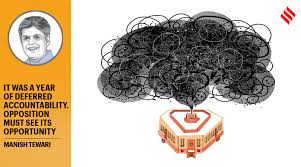
Editorial 1 : Deferred Accountability
Context
The year 2025 highlighted serious deficiencies in governance, internal security, foreign policy management, institutional accountability, and infrastructure safety, exposing a widening gap between constitutional ideals and political practice.
Introduction
The concluding year revealed a pattern of governance marked by delayed accountability, reactive decision-making, and systematic weakening of democratic institutions. From prolonged internal conflicts and national security lapses to regulatory failures and centralisation of power, governance increasingly appeared driven by political expediency rather than constitutional responsibility. The editorial argues that this crisis also presents a defining opportunity for the Opposition to reassert democratic checks and balances.
Governance and Constitutional Concerns
- The prolonged ethnic violence in Manipur exposed failure of state capacity and crisis governance
- Imposition of President’s Rule reflected an admission of administrative collapse rather than resolution
- Ethnic divisions deepened while democratic processes remained suspended
- Repeated cycles of violence undermine constitutional guarantees under Articles 14 and 21
- The situation reflects weakening cooperative federalism and Centre–State trust
National Security and Internal Threats
- The Pahalgam terror attack revealed intelligence coordination and preparedness failures
- Military responses demonstrated tactical capability but lacked strategic deterrence clarity
- The challenge of responding to asymmetric warfare by a nuclear-armed adversary remains unresolved
- The Red Fort blast underscored the rising threat of homegrown radicalisation
- Absence of strong parliamentary oversight over intelligence agencies weakens accountability
Parliamentary Functioning and Democratic Accountability
- Parliamentary debates increasingly degenerate into partisan confrontation
- Substantive discussion on national security doctrine and preparedness remains limited
- Lack of ministerial moral responsibility reflects erosion of parliamentary conventions
- Deferred accountability has become a recurring governance pattern
Institutional Erosion and Electoral Integrity
- Changes in the Election Commissioner appointment process diluted institutional independence
- Removal of the Chief Justice from the selection panel weakened constitutional balance
- The Special Intensive Revision exercise risks mass disenfranchisement
- Such actions threaten free and fair elections, a core feature of democracy
Foreign Policy and Strategic Challenges
- India–US relations faced uncertainty amid shifts in American political priorities
- Rigid diplomatic approaches struggled against transactional global politics
- “Neighbourhood First” policy encountered stress due to political instability in Bangladesh, Sri Lanka, and Nepal
- China engagement remains superficial, masking unresolved border tensions
- A widening trade deficit with China reflects lack of a coherent long-term strategy
Economic and Social Policy Drift
- Economic policymaking appeared driven by electoral pressures rather than vision
- Income tax and GST cuts lacked integration into a clear fiscal framework
- The sudden announcement of a caste census marked an ideological reversal
- Absence of robust data architecture undermines meaningful social justice outcomes
- Persistent challenges include unemployment, inflation, and rural distress
Legislative Overreach and Centralisation of Power
- The SHANTI Act diluted nuclear liability norms, risking public safety
- Laws in education, sports governance, and digital regulation indicate central overreach
- Federal principles and institutional autonomy face systematic erosion
- Digital Personal Data Protection Rules raise concerns over privacy and state surveillance
Infrastructure Failures and Regulatory Weakness
- Railway accidents and bridge collapses exposed maintenance and oversight gaps
- These failures reflect neglect rather than unavoidable natural causes
- The Air India Flight 171 crash raised concerns over aviation safety regulation
- Regulatory institutions appeared constrained in holding powerful corporate actors accountable
- Growing duopolies distort competition and weaken consumer protection
Culture of Optics over Accountability
- Disasters were followed by ex-gratia announcements and inquiries
- Ministers rarely accepted moral responsibility
- This reinforces a governance culture focused on optics rather than corrective action
- Public trust in institutions continues to erode
Role of the Opposition
- The INDIA bloc, with 230 seats, carries a constitutional responsibility
- The Opposition must move beyond fragmented resistance
- Key focus areas include unemployment, inflation, rural distress, and welfare erosion
- A united, policy-driven alternative is essential
- Credible positions are required on national security, federalism, economy, and institutional reform
Way Forward
- Restore institutional autonomy and parliamentary oversight
- Shift from reactive to strategic governance and security planning
- Strengthen cooperative federalism and decentralisation
- Ensure transparent, consultative, and data-driven policymaking
- Reinforce accountability as a core democratic value
Conclusion
The editorial portrays 2025 as a year marked by deferred accountability, weakened institutions, and policy drift. Yet, it also frames this period as an inflection point for democratic renewal. Sustainable governance requires constitutional morality, institutional integrity, and political accountability. The Opposition’s ability to offer a coherent, policy-based alternative will determine the strength and resilience of India’s democracy going forward.
Editorial 2 : Quantum Science Impact
Context
Quantum physics, despite being counterintuitive, has had profound technological and scientific impacts over the past century, influencing energy, electronics, medicine, and computing.
Introduction
The editorial traces the development of quantum physics from Heisenberg’s foundational work in 1925 to its pervasive role in modern technology. Quantum theory, initially abstract and counterintuitive, has become central to innovations in semiconductors, lasers, nuclear energy, and medical diagnostics. The UN’s declaration of 2025 as the Year of Quantum Science and Technology underlines its global significance.
Historical Evolution
- In 1900, Max Planck introduced the concept of energy quanta to explain thermal radiation
- Albert Einstein applied quantum ideas to the photoelectric effect in 1905
- Niels Bohr decoded the hydrogen atom using quantum principles in 1913
- Heisenberg, with Max Born and Pascual Jordan, formalized quantum mechanics through matrix mathematics in 1925–26
- Other contributors included:
- Louis de Broglie (wave-particle duality)
- Erwin Schrödinger (wave equation)
- Satyendra Nath Bose (photon statistics leading to Bose-Einstein condensate)
- CV Raman (light-matter quantum interactions)
- Louis de Broglie (wave-particle duality)
Technological and Societal Impact
- Quantum principles led to semiconductors in the 1950s, lasers in the 1960s, and high-density data storage in the 1990s
- Medical and diagnostic technologies, including imaging devices, rely on quantum mechanics
- The theory continues to shape computing, communication, and emerging technologies like quantum computing and quantum sensing
- Investments in basic science demonstrate long-term dividends for society and industry
Philosophical and Global Significance
- Quantum mechanics transformed humanity’s perception of the universe
- Ideas from quantum physics influenced philosophy, religion, and worldviews globally, including Vedanta and Buddhism
- Scientific principles, initially abstract, now permeate daily life and economic development
Way Forward
- Continued investment in fundamental science is essential for technological leadership and innovation
- Policies should promote interdisciplinary research integrating physics, computing, and engineering
- Awareness of quantum science’s societal applications can enhance education, industry, and national competitiveness
Conclusion
It emphasizes that quantum physics, though conceptually challenging, has revolutionized science, technology, and society over the past century. Its story illustrates the importance of sustained research in basic sciences, demonstrating how curiosity-driven inquiry can yield transformative outcomes for humanity.
