

31 January 2026 The Hindu Editorial
What to Read in The Hindu Editorial ( Topic and Syllabus wise)
Article 1 : Stay on course
Why in news: The Supreme Court of India stayed the University Grants Commission’s Equity in Higher Education rules, terming them too sweeping. The stay has revived debate on caste discrimination, student protections, and the balance between effective redressal mechanisms and procedural fairness on campuses.
Key Details
The Supreme Court of India has stayed the UGC’s Promotion of Equity in Higher Education Institutions Rules, describing them as “too sweeping.”
The rules were notified in January following a Supreme Court directive to address discrimination in higher education institutions.
They were framed against the backdrop of long-standing activism, litigation, and tragic incidents such as the Rohith Vemula case, which highlighted caste-based discrimination on campuses.
The earlier 2012 UGC framework on discrimination was largely ignored by HEIs, prompting the need for stronger regulations.
UGC data indicates that complaints related to discrimination in HEIs have more than doubled in the last five years.
Background
The Supreme Court of India stayed the UGC’s Promotion of Equity in Higher Education Institutions Rules, terming them “too sweeping.”
The rules were notified in January following a Court mandate to the University Grants Commission.
They aimed to address all forms of discrimination, with a focus on caste-based discrimination, after years of activism, litigation, and tragedies like the Rohith Vemula suicide that shook public conscience.
Need for the Rules
The 2012 UGC framework on campus discrimination was largely ignored by HEIs.
Caste-based discrimination remains a persistent reality, causing deep psychological harm, lifelong scars, and at times loss of life.
UGC data shows that complaints have more than doubled in the past five years, underlining the urgency of reform.
Evolution of the Rules
Draft rules were released last year for public consultation and later notified with changes.
Critics argue the new rules dilute the 2012 framework, which had:
Identified more varied forms of discrimination
Dedicated provisions for SC/ST students, including non-implementation of reservation norms
What Is New
Mandatory establishment of:
Equal Opportunity Centres
Equity Committees
Equity Helplines and Squads
Introduction of time-bound grievance redressal.
Stronger monitoring, oversight, and representation in inquiry committees.
UGC action against non-compliant HEIs, potentially improving enforcement.
Concerns and Protests
Protests in parts of northern India over two issues:
Caste-based discrimination is defined as applicable only to SC/STs and OBCs.
No provision to act against false complaints.
The definition is seen as unfair by general category students, who feel denied recourse.
Possible Course Correction
While discrimination largely targets lower castes, the Court could consider removing the explicit caste definition to broaden protection.
This may affect political signalling, but could help achieve the core objective of equity.
The 2025 draft rules had provisions to deal with false complaints.
Reintroducing them risks a chilling effect on marginalised complainants.
A balanced solution could allow action only against complaints proven to be malicious, not those that fail due to lack of evidence.
Way Forward
The Court could consider removing the explicit caste definition, allowing a broader interpretation while retaining the spirit of the rules.
A balanced mechanism may be evolved where:
Only proven, maliciously motivated complaints are actionable.
Complaints that fail due to lack of evidence are not penalised.
Strengthening institutional sensitivity, awareness, and independent oversight can improve trust in grievance mechanisms.
Conclusion
Addressing caste-based discrimination in higher education must remain a political, social, and educational priority.
While procedural refinements are necessary, the core objective of equity and inclusion should not be diluted.
Effective implementation, rather than rollback, is essential to ensure safe, inclusive, and just campuses for all students.
Descriptive question:
- Discuss Supreme Court’s stay on UGC equity rules, highlighting objectives, concerns, protests, and suggested reforms. (10 marks, 150 words)
Article 2 : The 27th amendment, Pakistan’s democratic dilemma
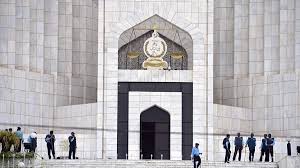
Why in news: Pakistan’s 27th Constitutional Amendment (PCA) is in focus as it curtails the powers of the Supreme Court of Pakistan by transferring key constitutional jurisdiction to a new Federal Constitutional Court, raising concerns over judicial independence, executive dominance, and the rule of law in Pakistan.
Key Details
Amendment: 27th Constitutional Amendment (PCA)
Core Change: Transfer of constitutional jurisdiction from Supreme Court to FCC
Primary Risk: Executive influence over constitutional interpretation
Background and Nature of the Amendment
Last year (November 12–13), Pakistan’s legislature passed the 27th Constitutional Amendment (PCA), later receiving presidential assent
Publicly framed as a reorganisation of the military command structure, the amendment has deep constitutional implications
The PCA reduces the centrality of the Supreme Court in Pakistan’s constitutional framework
Original jurisdiction over constitutional interpretation, fundamental rights, and federal–provincial disputesis shifted to a new Federal Constitutional Court (FCC)
This move sidelines the Supreme Court from the most critical questions of governance
Impact on Judicial Authority
The transferred jurisdiction earlier enabled the Supreme Court to decide landmark political cases such as the Panama Papers and Memogate matters
Removing this authority fragments constitutional adjudication
It weakens the Supreme Court’s role as the final guardian of the Constitution
The Court becomes institutionally vulnerable, particularly to executive influence
Regional Context and Constitutional Strain
The PCA must be seen within a broader South Asian context marked by
Political instability
Security challenges
Institutional stress
In the Global South, where governance often competes with security imperatives, constitutional design choiceshave long-term consequences
These developments are not isolated, and their effects often spill across borders
Why It Matters Beyond Pakistan
For India, observing constitutional shifts in the neighbourhood is neither adversarial nor voyeuristic
As the region’s largest constitutional democracy, India has a direct stake in how constitutional norms evolve or erode around it
The weakening of judicial independence or normalisation of executive dominance elsewhere offers clear cautionary lessons
Rule of Law and Constitutional Balance
At the heart of constitutional governance lies A.V. Dicey’s concept of the rule of law
This doctrine rests on
Absence of arbitrary power
Equality before the law
Independent courts as guardians of rights
Courts, in this framework, act as sentinels restraining authority
The PCA disturbs this equilibrium by diluting the Supreme Court’s role as final constitutional arbiter
The Federal Constitutional Court Question
The creation of the FCC is constitutionally significant
While specialised courts are not inherently problematic,
Removing constitutional review from the Supreme Court upsets a balance restored by the 18th Constitutional Amendment
That earlier amendment aimed to
Depoliticise judicial appointments
Strengthen the Judicial Commission of Pakistan
Insulate the judiciary from executive dominance
The PCA raises concerns about executive influence over the FCC’s composition and functioning
Judicial legitimacy flows from independence, not mere institutional existence
Historical Perspective on Judicial Independence
In early 17th-century England, King James I claimed the right to personally adjudicate disputes
This was firmly resisted by Sir Edward Coke, then Chief Justice
Coke asserted that the king was subject to the law and could not sit in judgment
This episode established a foundational constitutional principle
Judicial authority must remain independent of executive will
Courts cannot function as neutral arbiters when operating under political shadow
Why It Matters for India
The late 20th century saw new nations adopt written constitutions to bind and restrain power
The 21st century presents a more unsettling trend
Constitutions are increasingly reshaped to concentrate power, not deepen democracy
The PCA reflects this shift by risking a transformation of the Constitution
From a shield against power
Into a tool of governance
History shows, particularly in inter-war Europe, that democratic breakdown often occurred through
Formally valid legal changes
Gradual hollowing out of institutions, not sudden coups
Way Forward
Reaffirm judicial independence as a non-negotiable constitutional principle
Protect the Supreme Court’s role as final constitutional arbiter
Ensure transparent and insulated appointment mechanisms
Conclusion
Constitutional democracy survives not merely on text, but on institutional integrity
Independent courts, respect for boundaries, and a culture of restraint are essential
How republics treat their constitutions today will decide whether this century is remembered for
Democratic renewal, or
The quiet dismantling of constitutional spirit from within
Article 3 : A job well done
Why in news: The Economic Survey 2025–26, presented by V. Anantha Nageswaran, is in news for its balanced economic outlook, crisis warnings, and emphasis on an entrepreneurial State amid global uncertainty.
Key aspects
Data-driven and non-sensational assessment of the economy amid global uncertainty.
Advocacy of an entrepreneurial, risk-taking State to accelerate growth.
Warning of 10–20% chance of a severe global economic crisis in 2026.
Assertion that rupee depreciation reflects global capital flows, not weak fundamentals.
Push for strategic resilience and indispensability in global supply chains.
Caution against State-level fiscal populism despite improved Centre finances.
Context and overall assessment
The Economic Survey 2025–26, presented under the stewardship of V. Anantha Nageswaran, stands out for its balanced, data-driven and non-sensational approach.
At a time of global economic uncertainty and relative domestic stability, the Survey provides clear-eyed analysis to inform future-oriented policymaking.
It lays down a medium-term economic and governance framework, stressing realism over rhetoric.
Key ideas and policy thrust
The Survey introduces the idea of an “entrepreneurial state” that is agile, experimental and willing to take calculated risks.
It argues for a dynamic policymaking shift, where failure is accepted as part of learning, essential for growth acceleration.
With the COVID-19 shock behind, the emphasis is on policy-led momentum to propel the economy forward.
Global risks and domestic resilience
The Survey realistically flags a 10–20% probability of a global economic crisis in 2026, potentially worse than 2008.
Even the best-case global scenario envisages deterioration compared to 2025.
Despite this, India’s economy is portrayed as fundamentally strong, supported by robust data, while candidly acknowledging emerging vulnerabilities.
Macroeconomic concerns and structural weaknesses
The rupee depreciation is attributed largely to global capital flows towards AI-driven economies and safe-haven assets, not weak Indian fundamentals.
While a weak rupee benefits exporters, India’s import dependence means higher import costs, worsening pressures.
Trade trends reveal that India is not yet strategically indispensable in global merchandise supply chains.
To counter this, the Survey stresses strategic resilience as a pathway to eventual strategic indispensability.
Fiscal dynamics: Centre–State imbalance
The Survey calls for greater fiscal flexibility at the Centre to manage geopolitical and geoeconomic shocks.
At the same time, it warns States against fiscal populism, especially unconditional cash transfers.
While the Centre has more than halved its fiscal deficit ratio in five years, several States have slipped into revenue deficits.
This concern gains significance in a politically sensitive election year for multiple major States.
Other emerging challenges flagged
Ethanol production posing risks to food security.
The true economic costs of the transition to renewable energy.
Inadequate fodder availability, affecting agriculture and livestock.
Social and productivity impacts of “compulsive scrolling” due to excessive smartphone use.
By highlighting these, the Survey performs its role as an early-warning policy document.
Way forward
Adopt a risk-aware but bold policy stance, embracing experimentation with accountability.
Build strategic depth in manufacturing and supply chains to enhance global relevance.
Strengthen Centre–State fiscal coordination, discouraging short-term populism.
Address non-traditional risks—from digital behaviour to food-energy trade-offs—through evidence-based interventions.
Use the Survey as a living guide, continuously updated with real-time data feedback.
Conclusion
The Economic Survey 2025–26 succeeds as a credible, forward-looking roadmap rather than a political manifesto.
Its strength lies in honest diagnosis, analytical restraint and policy pragmatism.
By balancing optimism with caution, it equips policymakers to navigate uncertainty while pursuing sustainable growth.
Prelims Question:
According to the Economic Survey 2025–26, a weaker rupee primarily benefits:
Importers
Consumers
Exporters
Service sector employees
Answer: c
