

From Prehistory to Civilization in India – Indian History
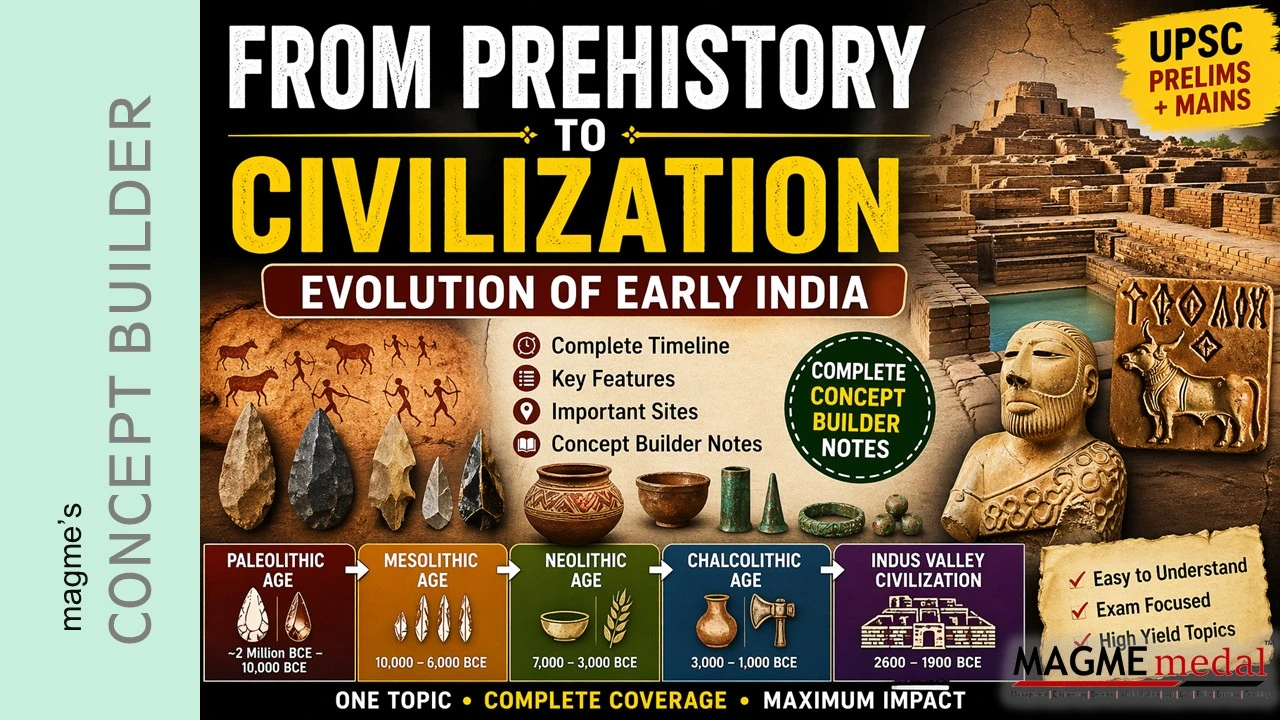
Magme Medal’s Concept Builder
From Prehistory to Civilization: Evolution of Early India
1. CORE TIMELINE (FOUNDATION)
|
Phase |
Period |
Identity Marker |
|
Paleolithic |
~2 million BCE – 10,000 BCE |
Hunting, crude stone tools |
|
Mesolithic |
10,000 – 6,000 BCE |
Microliths, transition |
|
Neolithic |
7,000 – 3,000 BCE |
Agriculture |
|
Chalcolithic |
3,000 – 1,000 BCE |
Copper use |
|
Indus Valley Civilization |
2600 – 1900 BCE |
Urban system |
👉 Prelims Key: Chronology + feature mapping
2. PALEOLITHIC AGE (OLD STONE AGE)
Concept Core
Earliest human phase marked by complete dependence on nature
Features
- Nomadic lifestyle
- Hunting & gathering economy
- No agriculture
- No pottery
Tools
- Quartzite stone tools
- Hand axes, cleavers
Sites
- Bhimbetka Rock Shelters
- Kurnool caves
- Hunsgi
Culture
- Early rock paintings
- No structured society
👉 Mains Insight:
Human survival strategy → environmental adaptation
3. MESOLITHIC AGE (MIDDLE STONE AGE)
Concept Core
Transitional phase between food gathering and food production
Features
- Semi-nomadic life
- Beginning of domestication
- Fishing and hunting
Tools
- Microliths (small, sharp tools)
Sites
- Bagor (Rajasthan)
- Adamgarh
👉 Prelims Key: Microlith = Mesolithic
👉 Mains Insight:
Climate change → lifestyle change
4. NEOLITHIC AGE (NEW STONE AGE)
Concept Core
Agricultural Revolution (Neolithic Revolution)
Features
- Agriculture begins
- Animal domestication
- Permanent settlements
- Food surplus
Tools
- Polished stone tools
Sites
- Mehrgarh
- Burzahom (Kashmir)
- Chirand (Bihar)
Cultural Developments
- Pottery
- Burial systems
- Social organization
👉 Mains Insight (VERY IMPORTANT)
Agriculture → surplus → specialization → trade → civilization
5. CHALCOLITHIC AGE (COPPER-STONE AGE)
Concept Core
Transition from stone to metal use
Features
- Copper + stone tools
- Rural settlements
- Regional cultures
Cultures
- Ahar
- Malwa
- Jorwe
Economy
- Agriculture dominant
- Beginning of trade
👉 Prelims Trap:
Chalcolithic = NOT urban
👉 Mains Insight:
Technological shift → socio-economic diversification
6. INDUS VALLEY CIVILIZATION (IVC)
Concept Core
First urban civilization in India
Major Sites
- Harappa
- Mohenjo-daro
- Lothal
- Kalibangan
Urban Planning (Highly Important)
- Grid pattern cities
- Advanced drainage system
- Citadel + lower town
Economy
- Agriculture (wheat, barley)
- Trade with Mesopotamia
- Standard weights and measures
Society
- No clear monarchy evidence
- Possibly egalitarian
Religion
- Proto-Shiva (Pashupati seal)
- Mother Goddess worship
- Fire altars
Script
- Undeciphered
👉 Prelims Trap: Script not yet understood
Decline Theories
- Climate change
- River drying (Ghaggar-Hakra)
- Ecological imbalance
- Decline of trade
7. EVOLUTIONARY FLOW (MOST IMPORTANT FOR MAINS)
👉 Use this flow in answers:
Prehistory
→ Hunting & Gathering
→ Domestication
→ Agriculture
→ Surplus
→ Trade
→ Urbanization
→ Civilization
8. PRELIMS RAPID REVISION
|
Age |
Key Marker |
|
Paleolithic |
Hand axes |
|
Mesolithic |
Microliths |
|
Neolithic |
Agriculture |
|
Chalcolithic |
Copper |
|
IVC |
Urban planning |
9. MAINS ANSWER FRAMEWORK
Introduction
Define prehistoric to protohistoric transition
Body
- Chronological evolution
- Technological changes
- Economic transformation
- Social development
Conclusion
IVC = culmination of long evolutionary process
10. MAGME MEDAL MEMORY CODE
👉 P – M – N – C – I
- Paleolithic
- Mesolithic
- Neolithic
- Chalcolithic
- Indus Civilization
