

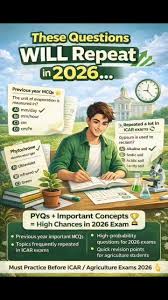
Essential Study Materials For Agriculture Entrance Exams
Preparing for agriculture entrance exams requires the right combination of books, notes, and practice resources. Many students make the mistake of using too many materials, which leads to confusion. The key is to choose limited but high-quality resources aligned with the syllabus.
1. NCERT Books – The Foundation
The most important and non-negotiable study material is NCERT.
Must-Study NCERT Books:
- Class 11 & 12 Biology
- Class 11 & 12 Chemistry
- Class 11 & 12 Physics
These books form the base of almost 70–80% of the questions in exams like ICAR AIEEA.
Experts strongly recommend mastering NCERT line-by-line before moving to advanced books.
2. Standard Agriculture Books
For agriculture-specific topics, these books are highly useful:
Recommended Agriculture Books:
- Handbook of Agriculture
- Agriculture at a Glance – R.K. Sharma
- Fundamentals of Agriculture – Arun Katyayan
- Objective Agriculture – S.R. Kantwa
These books cover topics like:
- Soil science
- Agronomy
- Horticulture
- Crop production
They also include updated concepts and practical knowledge required for exams.
3. Entrance Exam Guidebooks
Guidebooks are essential for understanding exam patterns and practicing questions.
Popular Guidebooks:
- NTA ICAR AIEEA UG Entrance Exam Guide – R. Gupta
- CUET-ICAR AIEEA Agriculture Guide – RPH Editorial Board
- BSc Agriculture Entrance Exam Guide – Arihant Experts
These books provide:
- Previous year solved papers
- Model questions
- Practice tests
They are specifically designed according to the latest exam pattern.
4. Subject-Wise Reference Books
To strengthen individual subjects, use these:
Biology
- Trueman’s Elementary Biology (Vol 1 & 2)
- Objective Biology
Chemistry
- Organic Chemistry – O.P. Tandon
- Objective Chemistry – R.K. Gupta
Physics
- Concepts of Physics – H.C. Verma
- NCERT + numerical practice books
Mathematics (if applicable)
- R.D. Sharma
- R.S. Aggarwal (Objective Maths)
These books help in deep conceptual understanding and problem-solving.
5. Previous Year Question Papers (PYQs)
One of the most powerful study tools.
Why PYQs are Important:
- Show real exam pattern
- Highlight important topics
- Improve accuracy
Many preparation books include 10–15 years of solved papers, which are extremely valuable.
6. Online Study Materials
Digital resources are increasingly important.
Useful Online Resources:
- Mock test platforms
- YouTube lectures
- PDF notes & question banks
These help in:
- Quick revision
- Concept clarity
- Practice anytime
7. Mock Tests & Practice Papers
Mock tests simulate real exam conditions.
Benefits:
- Time management
- Speed improvement
- Confidence building
Attempt at least 20–30 full-length mock tests before the exam.
8. Short Notes & Revision सामग्री
Self-made notes are extremely effective.
What to Include:
- Formulas
- Important facts
- Diagrams
- Key concepts
These are crucial for last-minute revision.
9. Recommended Study Material Strategy
Ideal Combination:
- NCERT (Base)
- One agriculture book
- One guidebook
- Previous year papers
- Mock tests
Avoid using too many books — it reduces efficiency.
10. Common Mistakes to Avoid
- Ignoring NCERT
- Using too many reference books
- Not solving PYQs
- Skipping mock tests
- Lack of revision
11. Pro Tips for Smart Preparation
- Stick to limited resources
- Revise multiple times
- Focus on weak areas
- Practice daily MCQs
- Analyze mistakes
Conclusion
The right study material can make a huge difference in your preparation for agriculture entrance exams. Focus on NCERT fundamentals, standard agriculture books, and consistent practice through mock tests and PYQs.
Remember — success doesn’t depend on how many books you read, but on how well you understand and revise them.
Final Advice:
“Read less, revise more, practice maximum.”
