

03 April 2026 The Hindu Editorial
What to Read in The Hindu Editorial ( Topic and Syllabus wise)
Article 1: In the running
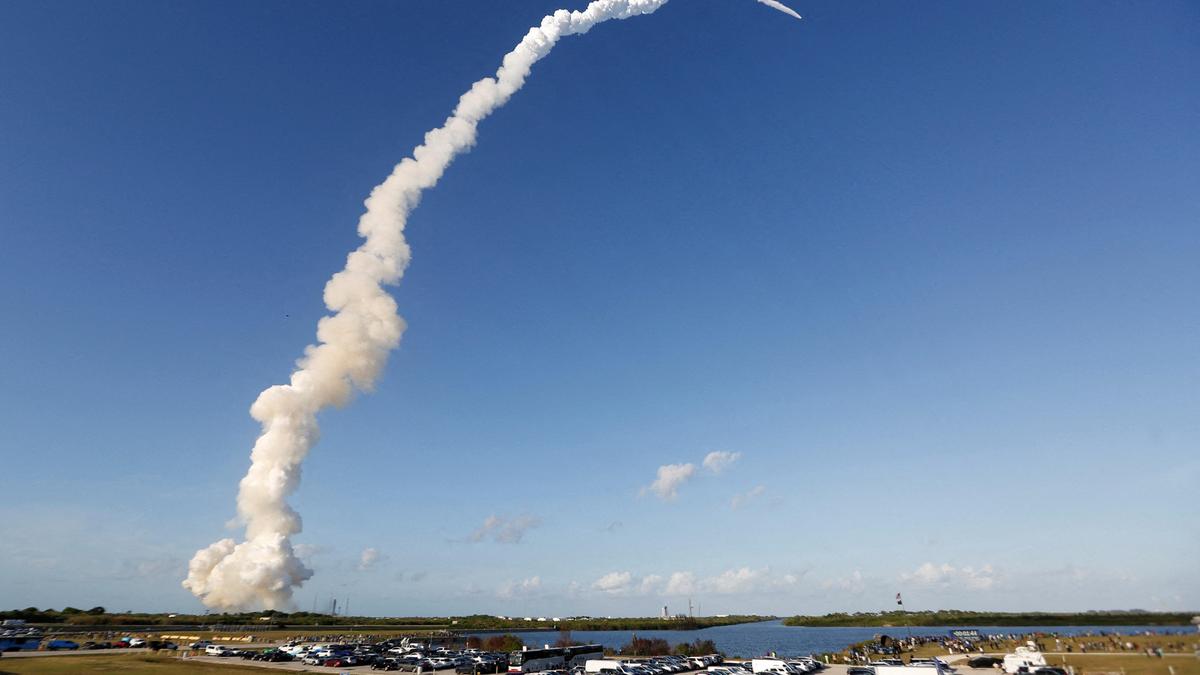
Why in news: The launch of Artemis II has renewed global attention on human spaceflight, highlighting intensifying competition between major powers and advancing prospects of returning humans to the Moon.
Key Details
Artemis II marks a critical step toward human return to the Moon.
U.S.–China rivalry is shaping a new lunar space race.
Focus on lunar resources, bases, and infrastructure development.
Space ambitions driven by geopolitics and national prestige, not just science.
India joined Artemis Accords; advancing Gaganyaan and future Moon plans.
Artemis II Launch & Significance
The launch of Artemis II created global excitement as the massive rocket carried four astronauts into space.
It marks a major milestone after years of development and heavy investment.
The mission brings humanity closer to returning to the Moon.
It represents a revival of human deep-space exploration efforts.
Seen as a symbol of technological advancement and ambition.
Emerging Global Lunar Competition
The U.S. and China are leading a new space race toward the Moon.
Competition is driven by access to water resources and strategic lunar locations.
Establishing lunar bases could give long-term advantages.
The race creates winners and losers, influencing future missions.
Raises concerns about fairness in shared space resources.
Strategic Importance of Lunar Infrastructure
Programmes like Artemis and China’s lunar plans aim to build:
Research stations
Refuelling depots
Communication systems
Resource extraction facilities
These assets provide a head-start for missions to Mars and beyond.
Control over such infrastructure enhances space dominance.
Focus is not just exploration but also long-term strategic positioning.
Expands human activity into cis-lunar space.
Geopolitics Driving the New Space Age
Space exploration is influenced by national prestige and geopolitical interests.
Extending influence into space reflects Earth-based power rivalries.
The idea of pure scientific exploration is somewhat idealistic.
Countries aim to strengthen global standing through space achievements.
Space is becoming a domain of strategic competition.
India’s Role & Future Opportunities
India joined the Artemis Accords in 2023.
Commits to peaceful, transparent, and cooperative space use.
India’s Gaganyaan is progressing.
Plans include building a space station and Moon mission by 2040.
Opportunities:
Contribute payloads and experiments
Collaborate on joint missions
Participate in lunar development under global frameworks
Conclusion
The Artemis II mission underscores a transformative phase in space exploration, where cooperation and competition coexist. While it accelerates humanity’s return to the Moon, it also reflects geopolitical rivalries shaping the new Space Age. For India, aligning with global frameworks while building indigenous capabilities offers a balanced path to benefit from emerging opportunities in lunar exploration and long-term space ambitions.
Prelims question:
- Artemis II mission is significant because it:
Lands humans on Mars
Is the first crewed mission of the Artemis program
Deploys satellites in Earth orbit
Tests space tourism
Answer: b
Article 2: A betrayal foretold
Why in news: Statements by Donald Trump on potentially withdrawing from NATO have raised concerns about transatlantic security, amid tensions over defence spending and the West Asia conflict.
Key Details
Donald Trump has questioned U.S. commitment to NATO, calling it ineffective.
Tensions linked to allies’ limited support in West Asia and Strait of Hormuz security.
U.S. criticises low defence spending by European members.
Legal constraints: U.S. President cannot unilaterally exit NATO without Congress approval.
Potential withdrawal may reshape global order, weakening alliances and forcing Europe to rethink security.
Growing Strain in Transatlantic Alliance
The U.S. may reconsider its 77-year partnership with Europe under NATO.
Donald Trump has indicated possible withdrawal, calling NATO a “paper tiger”.
Signals a potential major shift in global security arrangements.
Raises doubts about the future of collective defence commitments.
Could weaken long-standing Western unity.
West Asia Conflict as Immediate Trigger
U.S. dissatisfaction stems from limited allied support in West Asia.
Allies were slow to assist in securing the Strait of Hormuz.
The region is crucial for global oil supply routes.
U.S. expected stronger backing in operations involving Iran.
Lack of response intensified policy frustrations in Washington.
Burden-Sharing & Effectiveness Concerns
U.S. criticises NATO as a “one-way street” in terms of contributions.
European members accused of insufficient defence spending.
Trump questioned NATO’s military credibility and effectiveness.
Comments linked to Vladimir Putin and Russia’s actions in Ukraine.
Concerns about NATO’s ability to deter future threats, especially in Eastern Europe.
Legal & Institutional Constraints
U.S. law limits unilateral exit from NATO.
Requires two-thirds Senate approval or Congressional act.
Provision exists under 2024 National Defense Authorization Act.
Acts as a check on executive power in foreign policy.
Makes immediate withdrawal legally complex and uncertain.
Global Implications & Future Order
Possible U.S. withdrawal could reshape global power dynamics.
May create a security vacuum for emerging powers to exploit.
Reflects a shift toward American isolationism and dominance.
Risks weakening global trust and cooperative institutions.
Europe may need to rebuild its security architecture independently in a post-Pax Americana era.
Conclusion
The U.S.-NATO rift signals a possible shift from collective security to strategic uncertainty. While American retrenchment may open space for emerging powers, it risks undermining trust in global alliances and destabilising the rules-based order. Europe, in particular, will need to reassess its defence architecture, as evolving geopolitics redefine cooperation, security commitments, and the balance of power in a post-Pax Americana world.
Article 3: A path to peace in West Asia beyond Pakistan talks
Why in news: Recent diplomatic efforts led by Pakistan and regional powers to mediate the West Asia conflict highlight growing urgency for ceasefire, amid escalating tensions, humanitarian concerns, and global energy security risks.
Key Details
Pakistan hosted regional talks involving Saudi Arabia, Türkiye, and Egypt for mediation.
Immediate focus is on achieving a ceasefire between U.S./Israel and Iran.
Trust deficit and unclear war goals hinder negotiations.
Need for UN-backed peacekeeping force, but consensus remains difficult.
India can play a role by mobilising Global South diplomacy.
Diplomatic Engagements & Regional Initiatives
A high-level meeting in Pakistan involved Saudi Arabia, Türkiye, Egypt, and Pakistan to discuss peace.
Pakistan also engaged Iran and China through separate diplomatic talks.
Efforts reflect a growing regional push for mediation.
However, progress remains limited and complex.
Peace-building seen as a long and uncertain process.
Ceasefire as the Immediate Priority
The first essential step is achieving a ceasefire between U.S./Israel and Iran.
Unclear war objectives, especially from Donald Trump, complicate negotiations.
Israel seeks to weaken Iran’s military capability, delaying peace.
All sides continue to reject each other’s demands publicly.
War fatigue is emerging but not yet sufficient for compromise.
Challenges in Mediation & Trust Deficit
Lack of trust between parties undermines mediation efforts.
Accusations of continued attacks during negotiations worsen tensions.
A ceasefire requires credible enforcement mechanisms.
Any peacekeeping force would need a UN mandate.
However, global divisions make consensus difficult.
Role of Global Powers & Historical Lessons
Peace may depend on major power intervention and pressure.
Example: Suez Crisis resolved through UN General Assembly action.
Shows UN effectiveness depends on strong country support.
China may influence Iran but unlikely to offer security guarantees.
Risk of escalation prevents direct military involvement by major powers.
India’s Position & Global South Opportunity
India should avoid direct involvement but maintain dialogue with all sides.
Opportunity to mobilise the Global South for peace efforts.
Can push for ceasefire through multilateral forums like the UN.
Energy crisis impacts India and regional economies.
A collective diplomatic push may strengthen global pressure for peace.
Conclusion
The ongoing conflict in West Asia underscores the complexity of modern warfare, where diplomacy struggles against mistrust and shifting objectives. While regional mediation offers a starting point, lasting peace requires credible enforcement, global cooperation, and political will from major powers. India and the Global South can play a constructive role in advocating dialogue, stabilising energy concerns, and strengthening multilateral peace efforts.
Descriptive question:
- “Discuss the challenges of mediation in the West Asia conflict and evaluate the potential role of India and the Global South in ensuring a sustainable ceasefire.” (150 words, 10 marks)
