

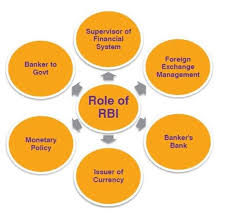
The Role Of The Reserve Bank Of India (RBI) In India’s Banking Sector
The Reserve Bank of India (RBI), established in 1935 under the RBI Act, 1934, is India’s central banking institution. It plays a pivotal role in regulating and supervising the banking sector, ensuring financial stability, and fostering economic growth. Below is a detailed analysis of RBI’s functions and responsibilities in India’s banking sector.
1. Monetary Authority & Policy Formulation
The RBI is responsible for formulating and implementing monetary policy to maintain price stability and ensure adequate credit flow in the economy.
Key Functions:
- Repo Rate, Reverse Repo Rate, and MSF (Marginal Standing Facility): Controls liquidity and inflation.
- Open Market Operations (OMO): Buys/sells government securities to regulate money supply.
- Cash Reserve Ratio (CRR) & Statutory Liquidity Ratio (SLR): Mandates banks to maintain reserves with RBI.
2. Regulator & Supervisor of Banks
The RBI oversees all banks in India, ensuring their safety, stability, and compliance with banking regulations.
Key Functions:
- Licensing & Regulation: Grants banking licenses and regulates operations.
- Prudential Norms: Enforces capital adequacy (Basel III norms), asset classification, and provisioning.
- Supervision: Conducts inspections (on-site & off-site) to monitor financial health.
- Corrective Measures: Imposes penalties, mergers, or liquidation of weak banks (e.g., Yes Bank restructuring).
3. Banker to Banks & Lender of Last Resort
The RBI acts as a bank for commercial banks, providing liquidity support in crises.
Key Functions:
- Maintains Banking Accounts: Holds CRR and SLR deposits.
- Provides Emergency Funding: Offers loans via the Liquidity Adjustment Facility (LAF).
- Prevents Bank Runs: Ensures public confidence by supporting distressed banks.
4. Currency Issuance & Management
The RBI has the sole authority to issue and manage India’s currency.
Key Functions:
- Issues New Currency Notes & Coins: Ensures adequate supply.
- Withdraws Old Notes: Demonetization (e.g., 2016) to curb black money.
- Prevents Counterfeiting: Implements security features in banknotes.
5. Foreign Exchange Management
The RBI regulates foreign exchange reserves and ensures exchange rate stability.
Key Functions:
- Manages Forex Reserves (~$600+ billion) to stabilize the rupee.
- Implements FEMA (Foreign Exchange Management Act, 1999).
- Intervenes in Forex Markets to prevent excessive volatility.
6. Payment & Settlement Systems
The RBI oversees safe and efficient payment systems in India.
Key Functions:
- Regulates NEFT, RTGS, IMPS, UPI, and Digital Payments.
- Promotes Fintech Innovations: e.g., Unified Payments Interface (UPI).
- Ensures Cybersecurity: Issues guidelines for digital banking safety.
7. Developmental Role
The RBI promotes financial inclusion and banking penetration in rural and underserved areas.
Key Initiatives:
- Priority Sector Lending (PSL): Mandates banks to lend to agriculture, MSMEs, and weaker sections.
- Pradhan Mantri Jan DhanYojana (PMJDY): Expands banking access.
- Regional Rural Banks (RRBs) & Cooperative Banks: Strengthens rural credit.
8. Consumer Protection & Grievance Redressal
The RBI safeguards customer interests in banking services.
Key Functions:
- Banking Ombudsman Scheme: Resolves customer complaints.
- Fair Practices Code: Ensures transparency in lending.
- Regulates Charges: Caps penalties, ATM fees, etc.
9. Financial Stability & Crisis Management
The RBI monitors systemic risks and prevents financial crises.
Key Functions:
- Financial Stability Reports (FSR): Assesses risks in the banking sector.
- Stress Testing: Evaluates banks’ resilience to economic shocks.
- Insolvency & Bankruptcy Code (IBC): Facilitates resolution of bad loans.
Conclusion
The RBI is the backbone of India’s banking sector, ensuring monetary stability, regulatory compliance, financial inclusion, and economic growth. Its proactive policies and supervisory mechanisms help maintain public trust in the banking system while adapting to global financial changes.
Key Takeaways:
Monetary Policy Controller
Banking Regulator & Supervisor
Currency Issuer & Forex Manager
Payment System Overseer
Financial Inclusion Promoter
Consumer Protector & Crisis Manager
The RBI’s multi-faceted role ensures a stable, efficient, and inclusive banking system in India.
